


The sales mistakes founders make are rarely obvious — they’re baked into how most people think selling works. Here’s something nobody warned me about when I started: the moment you launch a company, you’re a salesperson. Didn’t sign up for that? Too bad. Neither did I.
Most founders I’ve met came from somewhere — engineering, design, writing, product. They built because they loved building. The phone calls, the pitches, the “hey just circling back” emails? God, no. That’s for someone else to handle. Except it’s not. Not at first, anyway. And honestly, not ever — because if you can’t articulate why your thing is worth money, it doesn’t matter how good the thing is.
So let me walk you through the four traps I keep watching smart people fall into. Not because they’re bad at their jobs, but because nobody sat them down and said, look — the old-school sales playbook is poison.
Trap #1
Sales Mistake #1: Trying to “Win” the Call

🖼Trap 1 — The Closer MindsetTopic: A salesperson intensely leaning forward across a desk, pressure-filled atmosphere with a “WIN” target symbol — contrasted with a calm consultant figure listening with an open notebook.
Style/Color/Format: same as hero spec above. 3:2 aspect ratio.
Stop. Just… stop chasing the close.
I know that sounds counterintuitive. But think about the last time you walked into a store and a sales associate materialized out of nowhere with that look — hungry, eager, slightly desperate. What’d you do? You said “just browsing” and made a beeline for the exit. We’ve all been trained, almost Pavlovian-style, to feel a kind of low-grade threat the second someone seems to need us to buy something.
Your leads feel that too.
The fix isn’t a new script. It’s a mindset swap — from closer to consultant. When you genuinely go into a conversation wanting to figure out if you’re actually the right fit for someone, your whole energy shifts. You ask better questions. You listen to the answers instead of waiting for your turn to talk. And sometimes? You say, “honestly, I don’t think we’re what you need right now.” That line — I’ve seen it turn skeptics into evangelists. Trust is weird like that. Give it away and you get it back tenfold.

Trap #2
Sales Mistake #2: Listening for the Surface Problem

🖼Trap 2 — Surface vs Root ProblemTopic: An iceberg illustration — a tiny visible tip labeled “symptom” and a massive submerged block labeled “real problem.” A founder is looking only at the tip with a magnifying glass.
Style/Color/Format: same as hero spec above. 3:2 aspect ratio.
Here’s a classic scene: founder gets someone on the phone, the person mentions one pain point, and within ninety seconds the founder is doing a full feature walkthrough. Every bell, every whistle. I call it “pitch dumping” and it’s excruciating to watch.
Because here’s the thing — that problem they mentioned? It’s usually not the real problem. It’s the symptom.
Think about visiting a doctor. You say your arm hurts. A good doctor doesn’t immediately say “okay, we’re doing surgery Thursday.” They start asking questions. When did it start? What kind of pain — sharp, achy, does it radiate anywhere? What makes it worse? How’s your sleep been? They’re mapping out the whole picture before they even think about treatment.
Do that. When someone tells you their CRM isn’t working, don’t launch the demo. Ask why. Ask what it’s costing them. Ask if their team is quietly going rogue and keeping notes in random spreadsheets because the system is just too annoying. Ask if they’ve ever lost a client because something fell through the cracks. That’s when you find the wound. And once you find the wound, your solution doesn’t feel like a generic product — it feels like the exact thing they’ve been needing.
Trap #3
Sales Mistake #3: Pitching the Wrong Room
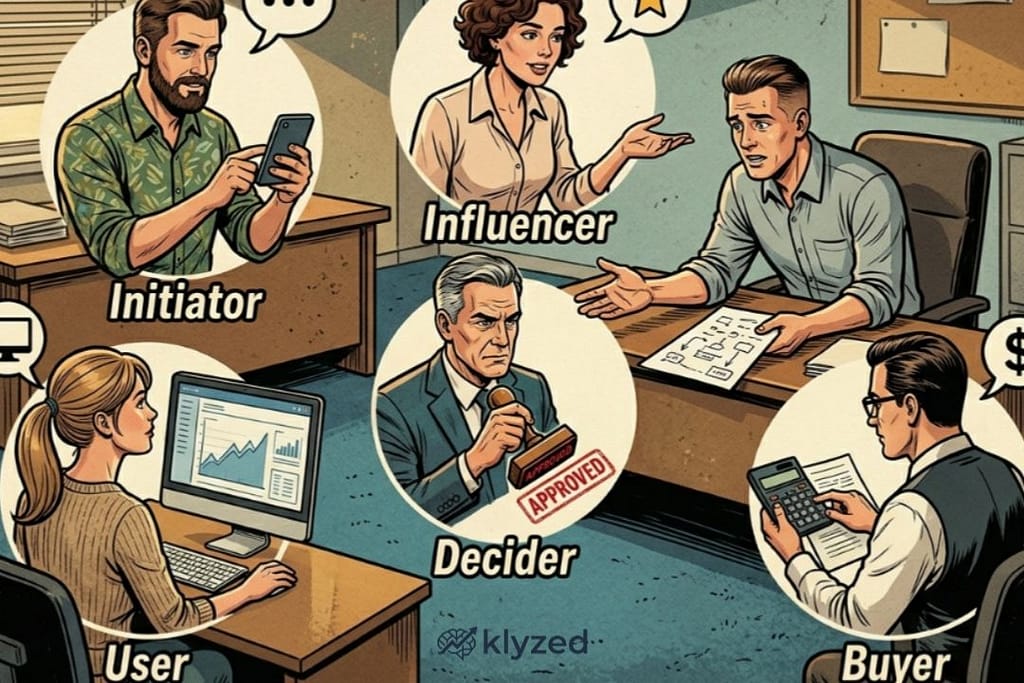
🖼Trap 3 — Stakeholder MapTopic: Five different flat-vector characters arranged in a circle — Initiator, Influencer, Decider, Buyer, User — each with a distinct icon (speech bubble, star, stamp, dollar sign, monitor). A founder figure pitching to only one of them.
Style/Color/Format: same as hero spec above. 3:2 aspect ratio.
You ever give a genuinely great pitch — like, you were on that day — and then nothing happens? The lead just kind of… ghosts? Chances are you were talking to the wrong person.
B2B sales especially has this weird ecosystem of stakeholders that founders chronically underestimate. There’s usually:
Whoever first complained about the current situation. Vocal, frustrated, but rarely the one with the budget.
The internal expert whose opinion carries weight without them even realizing it.
Actual authority to greenlight something.
Often the CFO or finance lead who cares about exactly one thing: the number.
The person who’ll actually live in your product every day and will kill the deal from below if it feels clunky.
There’s an old analogy about buying a sofa. The kid wants it. The mom picks the fabric. The dad pays. If you spend forty minutes explaining the payment plan to the dad but never address whether the fabric is kid-proof, you’re going home empty-handed.
Map the room first. Then pitch accordingly.
Trap #4
Sales Mistake #4: Misreading the “Too Expensive” Objection
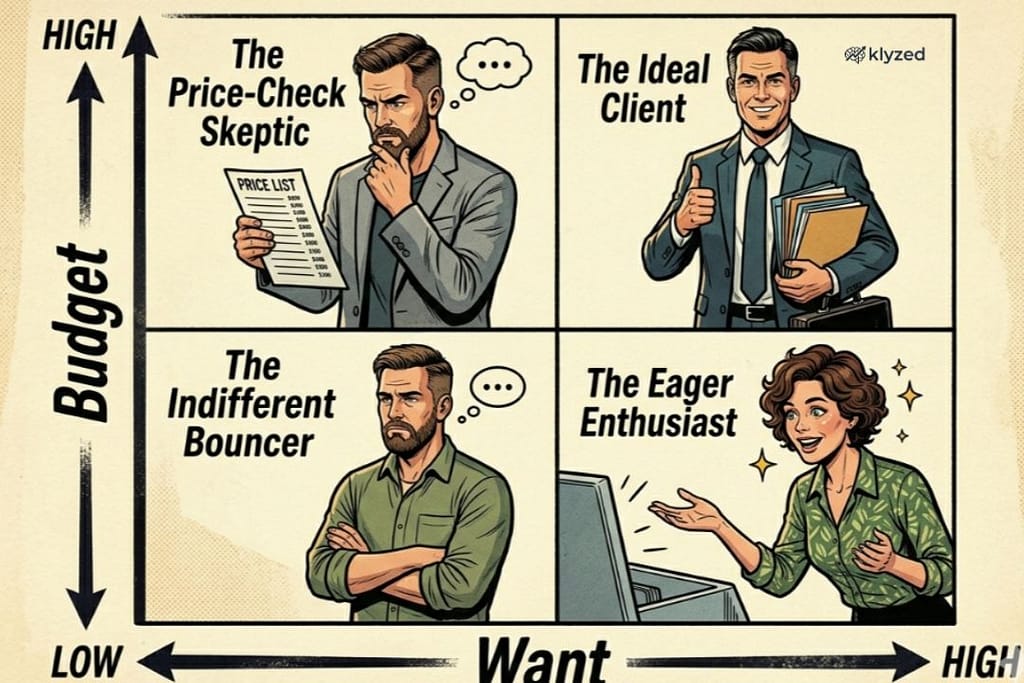
🖼Trap 4 — The Pricing GridTopic: A 2×2 grid with two axes — “Want” (low to high) and “Budget” (low to high) — four boxes filled with different customer types illustrated as flat characters with distinct emotions.
Style/Color/Format: same as hero spec above. 3:2 aspect ratio.
Money conversations make founders squirm. I get it. But here’s a framework that genuinely changed how I think about pricing objections.
Picture a simple grid. Two axes: how much they want your solution, and how much money they actually have available. Four boxes fall out of that:
These are your dream customers. Don’t overthink it, don’t discount, just close.
They believe in you, they just can’t swing a lump sum. Monthly options, stripped-down tiers, phased rollouts. These people become your loudest advocates.
Don’t drop the price. The problem isn’t the number — it’s that you haven’t made them care yet. Go back to Trap #2. A discount won’t manufacture urgency.
Hard truth: walk away. There’s no version of this conversation that ends well, and your time is worth something.
Knowing which box someone sits in before you start talking price? That changes everything.
📎 Related ReadPromotional Technique to Grow Your Business Faster — once you fix your sales process, this is how you fill the top of the funnel.
A Few Things People Ask Me
What if I’m an introvert? Sales feels physically unpleasant
Funny thing is, introverts are often better at this than extroverts once they understand the model. You’re not performing — you’re diagnosing. You listen, you notice things, you sit comfortably in silence while the other person fills it with useful information. That’s a superpower. Lean into it.
Should I ever mention competitors?
Sure, but don’t trash them. It reads as insecure and small. What works: “They’re excellent for enterprise-level companies — we’re specifically built for teams under fifty people.” Calm, confident, positions you without making you look threatened. See how Help Scout approaches this in their own competitive positioning guides.
How many follow-ups before I’m being annoying?
It’s not really about frequency — it’s about what you’re sending. “Hey just checking in” is noise. “Hey, I saw this article about the exact problem you described and thought you’d find it useful” is value. Be useful, not persistent. Yesware’s follow-up research backs this up with data.
The Short Version
Selling isn’t some dark persuasion art. At its core, it’s just problem-solving with better conversation. You’ve got something that fixes a real thing — your job is to find the person who has that real thing as their actual problem, figure out what it’s costing them, and help them see the path from where they are to somewhere better.
That’s it. That’s the whole game.
You’re already halfway there just by caring whether it works for them or not. Now go find someone’s problem you can actually solve.
Key Takeaways
Shift from closer to consultant. Your goal on the call is to figure out if you’re a fit — not to manufacture a yes.
Dig past the symptom. The problem they mention first is rarely the real problem. Ask deeper.
Map the room before you pitch. Know who the Initiator, Decider, Buyer, and User are before you go in.
Price objections are a want problem, not a number problem. Use the 2×2 grid to diagnose before you discount.
Combine sales with smart promotion. Fix your sales process, then amplify with a cross-promotional technique to bring more leads in.

Post navigation
Previous Post
 Promotional Technique to Grow Your Business Faster

Pingback: AI Business Idea Framework: Generate Ideas in 45 Minutes - Klyzed
Pingback: Time-Saving Tools 2026 - Reclaim 100 Hours [Expert Guide] - Klyzed
Pingback: How to Start a SaaS Business With No Money (2026 Guide) - Klyzed
Pingback: No One Is Going to Pay for My Vibe-Coded SaaS — Unless You Fix These Fundamentals - Klyzed
Pingback: How to build self-discipline: A guide to productive discomfort - Klyzed