
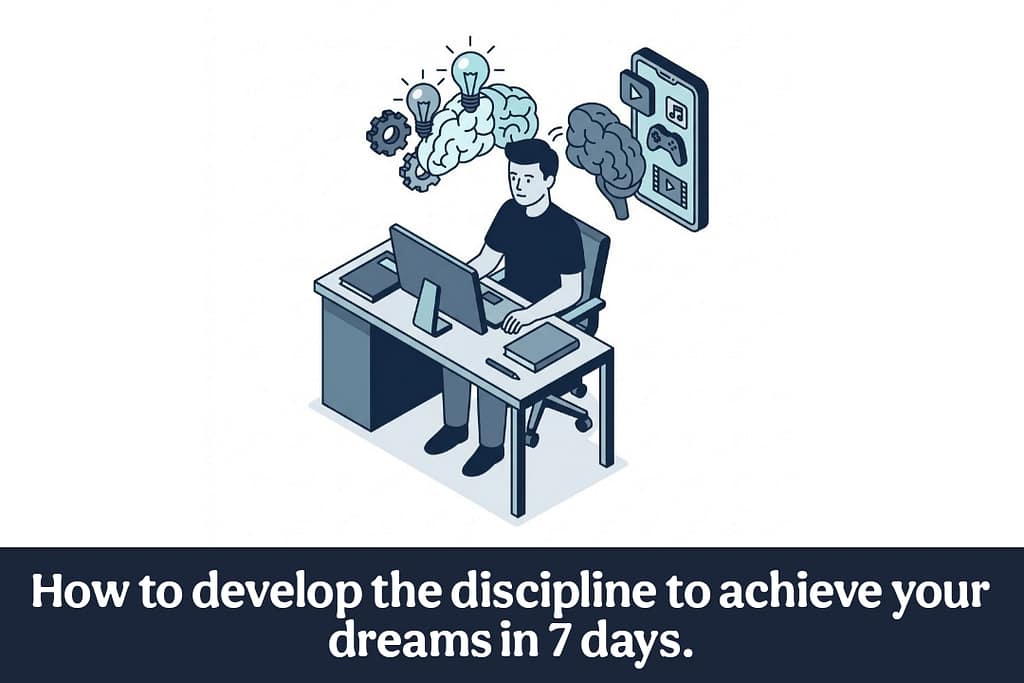

Here’s something I’ve never quite shaken when trying to build self-discipline: I can spend four hours deep in a YouTube rabbit hole—bad posture, cold coffee, completely forgetting I was supposed to eat—but the moment I open a blank document for something that matters, my brain just… evacuates the premises. Gone. Like it packed a bag and left a note.
That’s not laziness. I used to think it was, but it isn’t.
The Hidden Reason You Lose Focus
In fact, laziness would mean you don’t have the energy. However, you clearly do—you’ve got plenty of it for the stuff you love. The real problem is how your brain has categorized certain tasks: safe vs. threatening, rewarding vs. punishing. Consequently, once something lands in that second bucket, your nervous system quietly starts working against you. It’s almost impressively counterproductive.
Therefore, if you’re trying to figure out how to build self-discipline, here’s the thing nobody tells you upfront: it’s not a personality trait you either have or don’t. Rather, it’s more like a skill you develop through friction. Uncomfortable, occasionally embarrassing friction.
✦
Your Comfort Zone Isn’t the Enemy When You Build Self-Discipline.
Staying There Forever Is.
Every second person on the internet with a ring light and a motivational thumbnail will tell you your comfort zone is poison. A trap. A grave you dug yourself. And I get where that energy comes from—but essentially, it’s also kind of wrong.
After all, your comfort zone is where you recover. It’s Saturday morning. Maybe it’s your mom’s cooking. Or perhaps it’s that one playlist that never fails. There is absolutely nothing wrong with any of that.
The actual problem is never leaving. Your comfort zone is a resting ground — not a retirement home.
However, the actual problem—and I think this distinction matters more than people let on—is never leaving. For instance, there’s this pit stop analogy I keep coming back to: in a race, you have to stop. The car needs fuel, tires, adjustments. If you skip the pit stop entirely, you’ll break down somewhere ugly. But if you park yourself in the pit lane permanently? Well. You’re not racing anymore, are you.
Instead, think of your comfort zone as a resting ground. Not a retirement home.
Real growth lives in what some people call the Learning Zone—that slightly uncomfortable middle space where things are hard enough to stretch you but not so hard you shut down entirely. Ultimately, learning to build self-discipline is, in large part, just getting better at toggling between rest and that productive discomfort. Knowing when to push, and correspondingly, knowing when to stop.
✦
The Three-Ring Problem
(And Why “Just Try Harder” Is Terrible Advice)
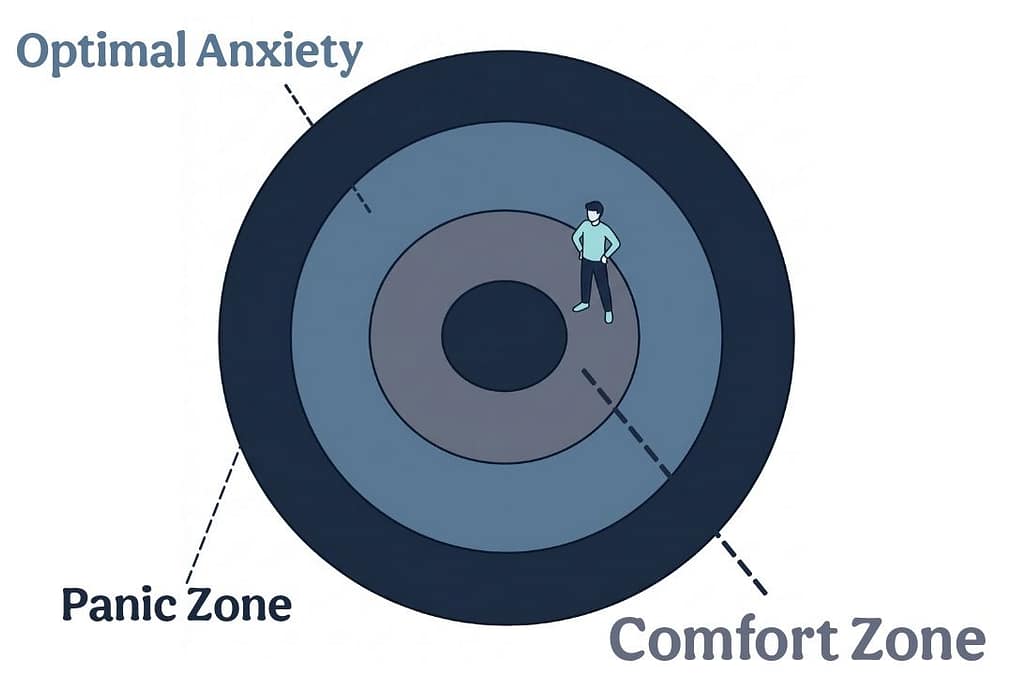
Picture three concentric circles. Dead center: your Comfort Zone. Zero pressure, zero growth. Outer ring—way out there—is the Panic Zone. That is exactly where your hands go clammy, your thinking goes sideways, and you’re basically just surviving.
Meanwhile, the middle ring is where you actually want to spend your working hours.
Furthermore, some researchers call it “optimal anxiety.” Personally, I’d describe it as that feeling right before you do something slightly terrifying but manageable—like your first presentation to a real audience, or cold-calling a client you’ve been putting off. There’s nerves, sure. But there’s also focus. Clarity, almost.
A surgeon mid-procedure isn’t relaxed. They’re not supposed to be. But they’re not panicking either—they’re operating in that exact middle ring. And critically, when the surgery’s over, they don’t immediately go do another one. They sit down. Afterward, they breathe. Finally, they recover.
That’s the model. Not grinding yourself into dust. Not coasting, either. Rather, it means moving deliberately between effort and rest, like someone who actually respects their own limits.
✦
Build the Net Before You Jump
G
G
enerally, most of us don’t start things because we’re scared. That’s the honest truth beneath all the productivity frameworks and morning routines.
We don’t launch the side project because we’re scared it’ll cost us money and fail publicly. Similarly, we avoid studying for the exam because what if we study hard and still fail—what does that say about us?
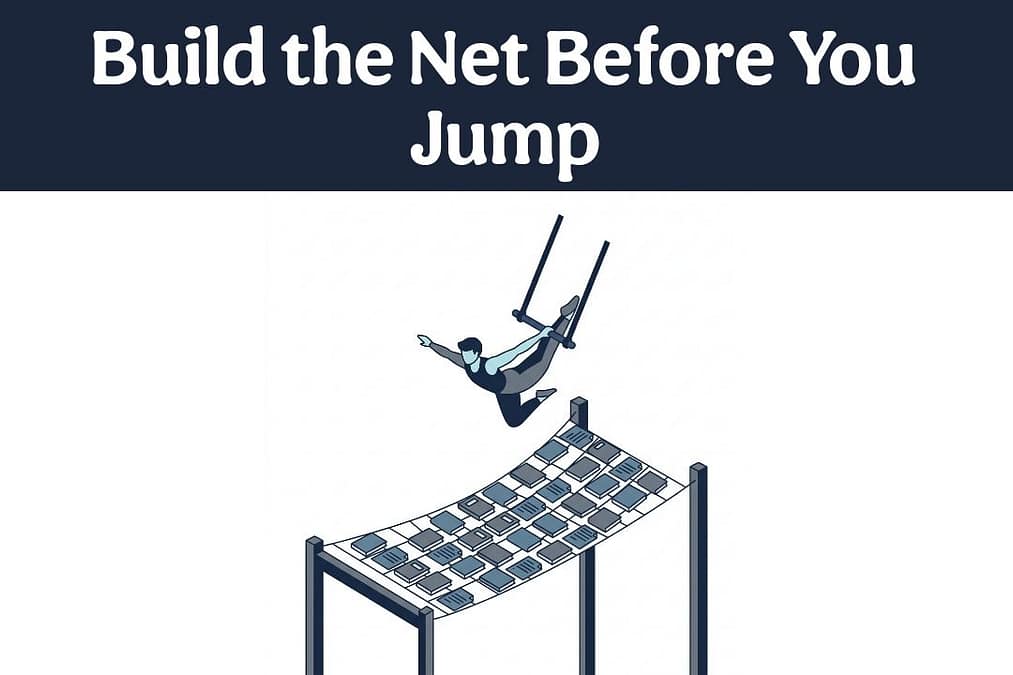
Here’s the reframe I find genuinely useful. Think about trapeze artists. They do genuinely insane things, mid-air, with total apparent calm. Why? Because there’s a net. They’ve built in the possibility of falling. Consequently, falling isn’t death; it’s just… falling. They simply bounce and go again.
Unfortunately, most of us skip that step. We stare at the high wire, see no net, and our brain—rightly, if annoyingly—refuses to move.
To fix this, building your safety net looks like knowledge. Specifically, the uncomfortable kind—not just the success stories, but the messy ones. Read about the entrepreneur who went bankrupt twice before figuring it out. Study the common failure patterns in whatever you’re trying to do. James Clear’s work on habit formation is a great starting point here. As a result, when your brain has a realistic map of what “failure” actually looks like—and it’s usually not catastrophic, just… inconvenient and instructive—it stops treating every difficult task like a survival threat.
Information is armor. Genuinely.
✦
The “All or Nothing” Trap Is Quietly Destroying Your Ability to Build Self-Discipline
Oh, this one. Without a doubt, this is the thought pattern I think does the most damage, partly because it masquerades as high standards.
“I only got twenty minutes of work done, so the whole day was pointless.” “I skipped the gym once, so the whole week is shot.” You know the voice. Maybe it even sounds a little like your own.
Binary thinking—win or lose, perfect or worthless—shoves you straight into the Panic Zone with no middle ground to land on. It’s exhausting. Moreover, it sets you up to quit, because the bar is always set in a place where quitting feels like the only sensible response. Indeed, this is closely related to the cognitive distortion of all-or-nothing thinking that psychologists have studied extensively.
Embracing Linear Thinking
You’re not at the beginning or the end. You’re on step fourteen of something that has a hundred steps. Step fifteen is all that matters right now.
On the contrary, what actually works is what I’d call linear thinking. Not winning or losing—just moving along a sequence. You’re not at the beginning or the end. Instead, you’re on step fourteen of something that has a hundred steps. Step fifteen is all that matters right now.
This doesn’t sound revolutionary written down like that. But applied? It changes everything. You’re not trying to transform your entire life today; you’re just sending one email. Similarly, you aren’t losing twenty pounds this week; just making one better food choice at lunch. The mountain stays the mountain. You simply stop staring at the summit and look at the path directly in front of your feet.
If this kind of thinking resonates, you might also find this helpful: Promotional Technique to Grow Your Business Faster — the same principle of consistent small steps applies directly to growing something you’re building.
✦
Seven Days of Intentional Weirdness
A
A
lright, enough theory. Here’s something concrete.
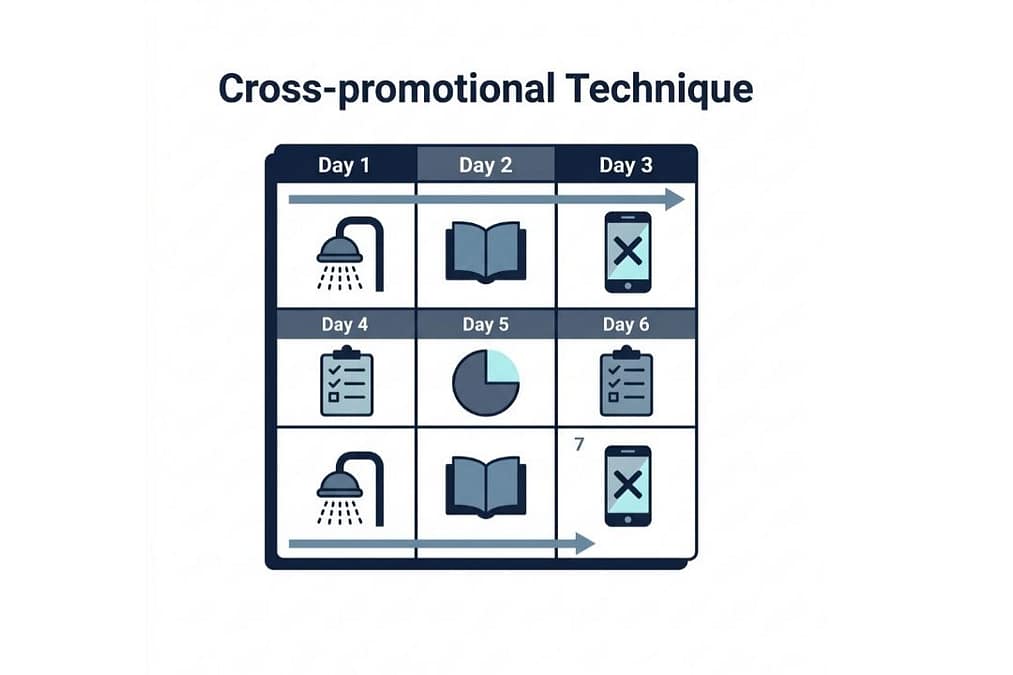
For the next seven days, deliberately do small things you don’t want to do. Not huge dramatic life changes—just minor rebellions against your own comfort. Things like:
Ultimately, the point isn’t perfection. The true goal is to repeatedly prove to your own nervous system that you are the one making decisions as you build self-discipline—not your cravings, not your comfort instincts. Every single time you do something you didn’t feel like doing, your mental flexibility grows. By day seven, you’ll notice something strange: things that felt genuinely hard at the start feel… almost ordinary. The scary stuff shrinks when you walk toward it.
✦
A Few Questions People Actually Ask When They Build Self-Discipline
✦
Everything you need to remember
Rest is part of the process — use your comfort zone to recover, not to hide.
Aim for that productive middle zone, not perfection and not panic.
Learn from failures (other people’s and your own) to build your safety net.
Replace all-or-nothing thinking with one-step-at-a-time.
Do the seven-day challenge — for real, not just mentally.
Avoiding common mistakes is just as important as building good habits. Read: Sales Mistakes Founders Make — 4 Traps to Avoid — the same “all or nothing” trap shows up in sales too.
✦
You are what you do,
not what you intend to do.
We’ve all got the movie-version of ourselves somewhere in our heads—disciplined, focused, getting things done at a beautiful desk with perfect lighting. And we will be that person… eventually.
But discipline doesn’t live in eventually. It lives right here, in the decision you make in the next five minutes. Close the tab. Start the thing. Wake up when the alarm goes off tomorrow instead of negotiating with it.
Pick one thing—not a list, not a system overhaul—just one thing. And do it now.




Pingback: Brain Performance: How to Sharpen Memory and Focus - Klyzed
Pingback: SaaS Launch Playbook: Scale to $61K MRR in 53 Days - Klyzed
Pingback: AI Startup Growth Hack: 7 Practical Ways to Scale Faster - Klyzed
Pingback: Mental Habits Successful Startup Founders Use to Scale - Klyzed
Pingback: AI Business Idea Framework: Generate Ideas in 45 Minutes - Klyzed
Pingback: How to Start a SaaS Business with $0: The Bootstrapper’s 2026 Guide - Klyzed
Pingback: Solo Developer Marketing 2026 – Grow Your App Alone [Proven System] - Klyzed
Pingback: How to Build Founder Resilience Under Pressure: 2026 Guide - Klyzed
Pingback: Daily Routines That Increase Founder Productivity (2026) - Klyzed