


Starting a SaaS business with no money sounds like one of those things people say but never actually do. I get the skepticism. But the honest truth is that the barrier to launching a software business has never been lower — and “I don’t have money” stopped being a valid excuse somewhere around 2019.
This is not a motivational post. This is a practical breakdown of how you actually build and launch a SaaS business from scratch, without a seed round, without a technical co-founder on retainer, and without burning through savings you don’t have.
Let’s get into it.

Can I Start a SaaS With No Money?
Key Insight
Yes — but with a caveat. You can start a SaaS business with no money if you’re willing to trade capital for time and effort. Free tiers on tools like Vercel, Supabase, and Stripe let you build and collect payments without upfront costs. The real investment isn’t financial — it’s the work of finding a real problem, validating it fast, and building just enough to charge someone.
The “no money” version of SaaS is not glamorous. There’s no fancy dashboard on day one, no designer, no agency handling your onboarding flow. But it’s real, and it works — if you approach it like a builder rather than a wishful thinker.
The founders who pull this off aren’t the ones with the best idea. They’re the ones who stay practical. They build lean. They talk to users constantly. They treat validation like oxygen — without it, nothing else moves.
What a Real Zero-Budget SaaS Stack Looks Like
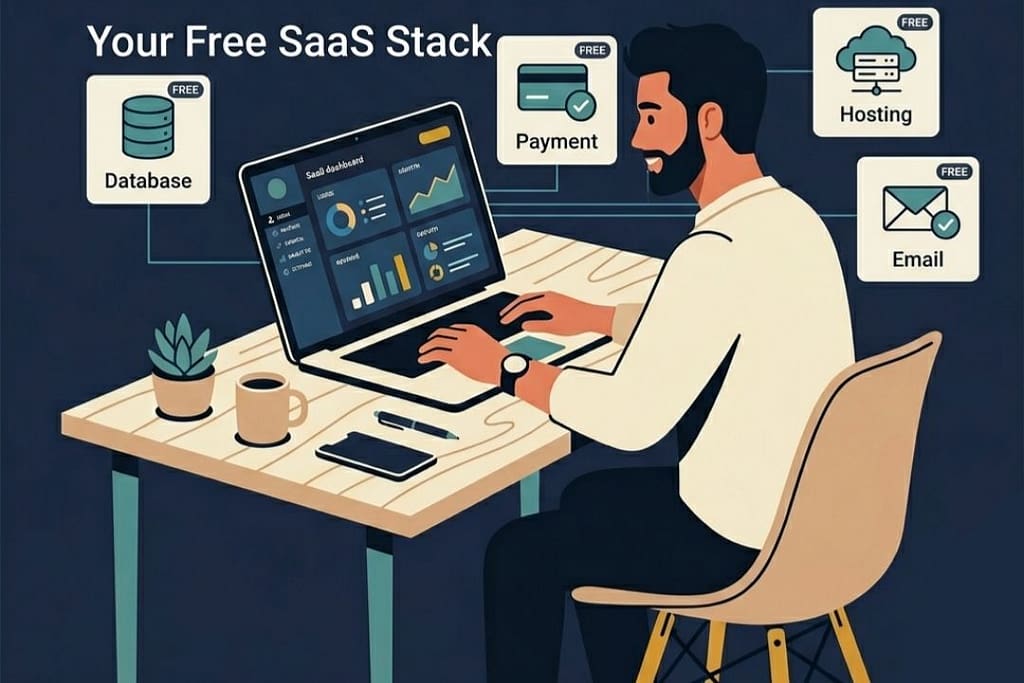
Before we talk strategy, here’s what a realistic no-cost stack looks like in 2025:
The only line item you truly can’t avoid is a domain. Everything else can be deferred until you have revenue.
How to Create Your Own SaaS Business — Step by Step
This is the part most articles gloss over. Here’s the actual sequence.
Step 1: Pick a Problem Worth Solving
Start narrow. Embarrassingly narrow. You are not building Salesforce. You are building something one specific type of person will pay $29/month for because it saves them two hours a week.
The fastest path to a real problem: look at the tools you already use, find what annoys you, and ask whether other people share that pain. Communities like Reddit, Indie Hackers, and niche Slack groups are goldmines here. One thread complaining about a broken workflow is worth more than a month of brainstorming.
Related Read
If you want a structured approach to generating and stress-testing ideas, the AI business idea framework on Klyzed covers this in a 45-minute process worth running through before you commit to anything.
Step 2: Validate Before You Build
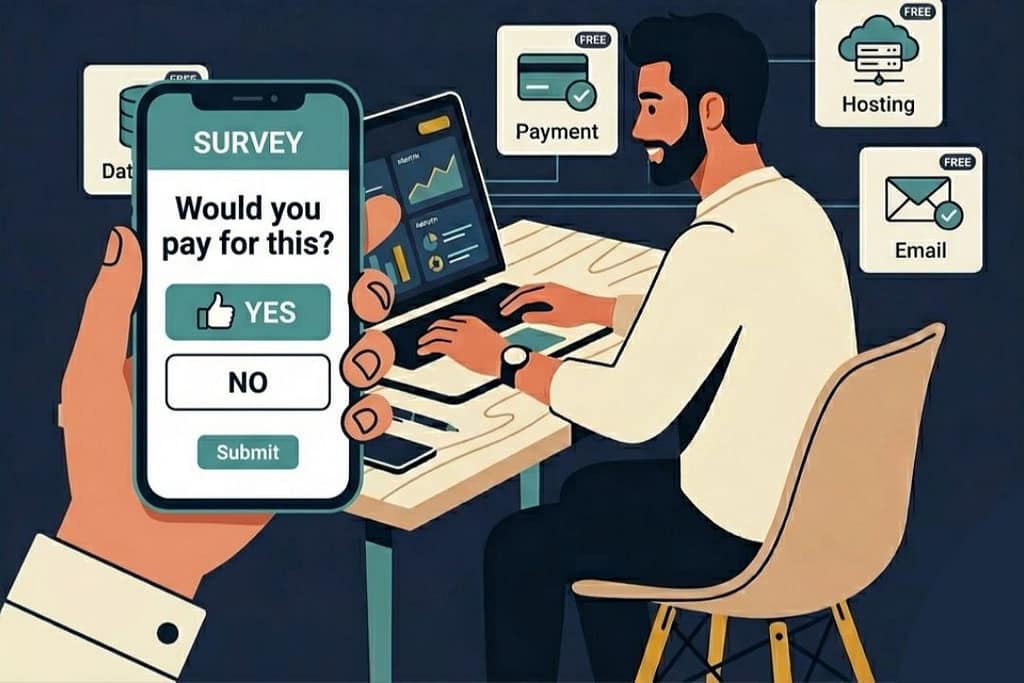
This step is where most people stall. Validation feels uncomfortable because it means putting an unfinished idea in front of real people. Do it anyway.
Validation can look like a 10-question survey in a niche subreddit. A Notion page with a waitlist form. A Loom video demoing a problem that doesn’t have a solution yet. A cold DM to 20 people who match your target user.
Quick Tip
What you’re looking for is not “that sounds cool.” You’re looking for “I would pay for that right now.” Those are completely different signals.
Step 3: Build a Lean MVP
An MVP is not a finished product with a rough design. It is the minimum thing that delivers the core value proposition. One use case. One user type. One outcome.
If you can code, build it yourself. If you can’t, tools like Bubble, Glide, and Softr let you ship functional apps without writing a line. Cursor and v0 have also dramatically reduced the time it takes to go from idea to working prototype, even for non-developers.
Important
The mistake I see constantly: spending months perfecting something nobody asked for. Ship ugly. Ship limited. Ship fast. Then improve based on what real users actually do with it.
Step 4: Get Your First Paying Users
Free users give you engagement data. Paying users give you signal.
Your first 10 customers will not come from SEO or paid ads. They come from direct outreach — LinkedIn DMs, community posts, cold emails, and telling everyone in your network what you built and who it’s for.
Related Read
The sales mistakes founders make post on Klyzed outlines exactly where early-stage founders blow the outreach part. Read it before you start.
Related Read
Cross-promotional strategies work well at this stage. Learn more: promotional techniques to grow your business faster.
Is $1,000 Enough to Start a SaaS Business?
Key Insight
Yes — $1,000 is more than enough to launch a SaaS business. In fact, with free tiers covering most infrastructure, $1,000 can fund 6–12 months of operations. The real budget goes toward a domain (~$12), a few paid tools once you outgrow free tiers, and maybe a small amount of test ads once you have a converting offer.
If you have $1,000, the highest-ROI move is not spending it on tools. It’s spending it on your own time — protecting it, focusing it, and building the kind of daily execution habits that actually move a product forward. That’s a harder skill to develop than most people expect.
Related Read
If you’re working on building that execution foundation, this guide to self-discipline and productive discomfort is worth your time.
Why 90% of Startups Fail (And How to Not Be One of Them)
Strategy
According to CB Insights, the top reason startups fail is no market need — cited by 35% of failed companies. The second is running out of cash (38%). Both failures trace back to the same root: building before validating, and spending before earning. The fix is sequential: validate first, build second, spend third.
The startups that survive the early stage have one thing in common — they stayed close to their users. Not theoretically. Literally. They ran calls, read support tickets obsessively, and changed direction based on real feedback, not gut instinct alone.
The other killer is founder burnout dressed up as “execution problems.” Building a SaaS alone is a long game.
Related Read
The SaaS launch playbook that helped one founder scale to $61K MRR is a good case study in what staying close to users and executing with discipline actually looks like in practice.
FAQ: Common SaaS Questions Answered
What is the 3 3 2 2 2 Rule of SaaS?
Definition
The 3 3 2 2 2 rule is a SaaS growth benchmark. It suggests that a healthy early-stage SaaS should triple revenue in years one and two (3x, 3x), then double it in the following three years (2x, 2x, 2x). It’s a framework used by VCs to assess growth trajectory — not a hard rule, but a useful benchmark for understanding what “good” looks like at different stages.
As a bootstrapped founder with no money, this framework is more useful as a mindset than a metric. It tells you that early-stage SaaS is about aggressive growth, not profit optimization. Your job in year one is not to build the most elegant product — it’s to grow as fast as you sustainably can.
The Real Advantage of Starting With Nothing
Here’s the counterintuitive part: starting a SaaS business with no money is actually a forcing function.
When you have no runway, you can’t afford to waste months building features nobody wants. You have to talk to customers before you write a single line of code. You have to charge early because you need the revenue. You have to stay lean because there’s no other option.
Key Insight
Constraints produce clarity. The founders I’ve seen build sustainable businesses without funding are almost always the ones who had the clearest picture of who their user was, what exact problem they were solving, and what “done” looked like for version one.
Money can paper over those gaps. No money can’t.
Final Thought
The question isn’t really “can I start a SaaS business with no money?” You already know the answer is yes.
The better question is: are you willing to do the slow, unglamorous work of validating before building, charging before perfecting, and staying consistent long enough to see traction?
If yes, the tools are free. The knowledge is available. The market is waiting.
Start ugly. Start now. Fix it as you go.
Key Takeaways
- You can start a SaaS with zero budget — tools like Vercel, Supabase, and Stripe make infrastructure nearly free.
- Validate before you build — the signal you want is “I would pay for that now,” not “that sounds cool.”
- An MVP is one use case, one user type, one outcome — not a polished product with rough design.
- Your first 10 customers come from direct outreach, not SEO or ads.
- 35% of startups fail from no market need. Validate first, build second, spend third.
- No money is a forcing function — it creates the clarity that funded founders often lack.




Pingback: No One Is Going to Pay for My Vibe-Coded SaaS — Unless You Fix These Fundamentals - Klyzed
Pingback: How to Get Users Using ChatGPT: The Founder's Playbook for AI-Driven Signups - Klyzed