

Is SaaS Dead? The Death Announcement Nobody Remembers Making
Here is the pattern: a new technology emerges, it gets breathless coverage, and within weeks someone draws a straight line from that technology to the extinction of SaaS. The argument sounds airtight in the moment. The logic always collapses within a year or two.
We are at one of those moments again. AI agents are the new villain. The claim is that autonomous software, powered by large language models, will make traditional SaaS apps redundant. Why pay for a project management tool when an agent can manage your projects? Why subscribe to a CRM when an agent can handle your pipeline?
It sounds compelling. And if you are a founder mid-build, or an operator deciding where to invest next, it creates real doubt. The fear is legitimate even if the conclusion is wrong. If you are still mapping out what to build, the AI business idea framework we covered here is a useful place to pressure-test your thinking before committing to a direction.
The problem is not that the fear exists. The problem is that it is based on a misunderstanding of what SaaS actually is, what AI agents actually do, and what business software actually needs to be useful at scale.
The people repeating “SaaS is dead” are conflating two separate things: the interface layer of software and the business model underneath it. Interfaces change. Business models are far more stubborn. SaaS — software delivered over the internet, hosted by the vendor, paid by subscription — is a business model, not a UI pattern. You can swap the front end entirely and the model survives.
The underlying demand for reliable, secure, workflow-specific software has not gone anywhere. If anything, the expansion of AI tooling is creating new categories of problems that need solving. Someone has to build those solutions. And the best way to deliver them and get paid for doing so is still, in 2026, a subscription.
HistoryA Timeline of Wrong Predictions About SaaS
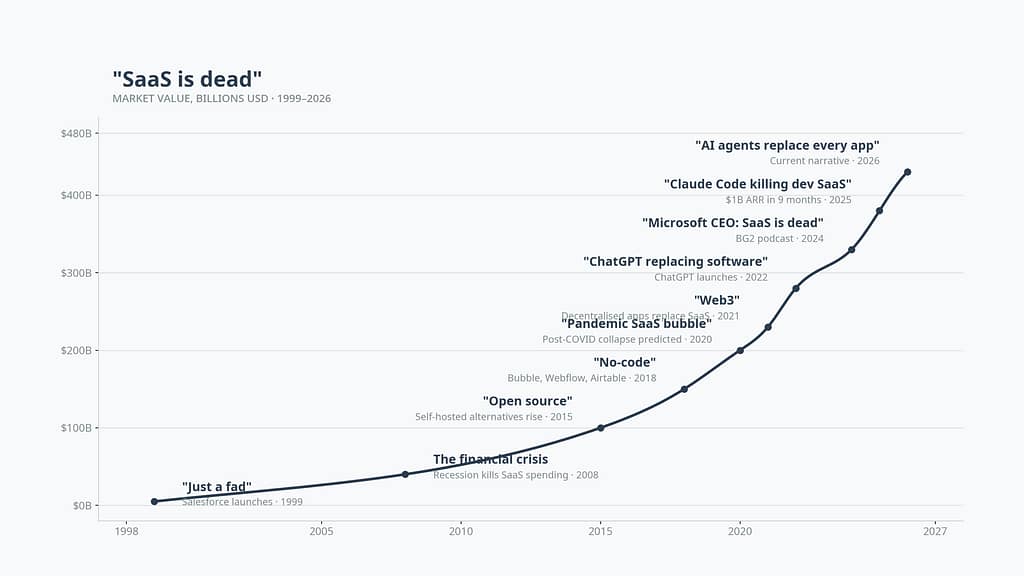
The death of SaaS has been announced on a remarkably consistent schedule. Here is the actual record:
- 1999Salesforce launches and is dismissed as a fad. It becomes one of the most valuable software companies on Earth.
- 2008The recession was supposed to kill SaaS spending. SaaS spending grew through the downturn because subscriptions offered more flexibility than large licensing deals.
- 2015Open source and self-hosted alternatives were going to make paid SaaS unnecessary. Both ecosystems grew, and SaaS grew alongside them.
- 2018No-code platforms like Bubble, Webflow, and Airtable were going to replace traditional software development. They became thriving SaaS businesses themselves.
- 2020The post-COVID SaaS bubble was supposed to collapse the whole category. Global SaaS revenue continued climbing.
- 2021Web3 decentralised apps were the future. That future did not arrive.
- 2022ChatGPT was going to replace software. ChatGPT became a SaaS product with millions of paying subscribers.
- 2024A high-profile CEO declared SaaS dead on a popular podcast. The SaaS market was worth over $375 billion and growing at roughly 18 percent annually. Cursor — an AI-powered coding tool — reached $2 billion in ARR faster than any company in history. Cursor is SaaS.
- 2025Claude Code hit $1 billion ARR in nine months. Also SaaS.
- 2026AI agents will replace every app. The cycle continues.
The pattern here is not subtle. Every predicted SaaS killer either failed to materialise or became SaaS itself. The addressable market is not shrinking — it is still, by almost any measure, in early innings. For a closer look at how founders have actually used these waves to grow, see our breakdown of 7 practical AI-driven growth moves that are working right now.
Key InsightWhat “SaaS Is Dead” Actually Means
Once you strip away the hype, “SaaS is dead” usually translates to something more specific and more accurate: lazy SaaS is under real pressure.
There is a meaningful difference between those two claims, and it is worth taking seriously.
What is genuinely at risk are thin-wrapper products — SaaS businesses that were essentially a light interface built over a third-party API, with minimal proprietary logic, no unique data, and no workflow depth. If an AI agent can replicate the core function of your product in an afternoon, your product probably was not solving a hard enough problem to begin with. This is exactly the kind of trap we cover in our post on the sales mistakes founders make when they chase the wrong problems.
AI agents do not kill SaaS. They become the engine inside it. The interface layer changes. The billing model does not. The delivery mechanism does not. What changes is what is possible — and that is an opportunity for builders, not a threat to the category.
The distinction that matters is between the SaaS business model and any specific SaaS product. The model is durable. Individual products are always at risk of being displaced by better solutions. That has always been true. AI does not change that dynamic — it accelerates it.
If you are building SaaS that is tied to real workflows, proprietary data, and genuine user outcomes, you are not building in a dying market. You are building in a market that is raising its standards. For a real-world example of what that looks like in practice, our SaaS launch playbook based on Rob Hoffman’s journey to $61K MRR shows how anchoring in a real workflow advantage compounds over time.

Why SaaS Survives Every Wave — and What Changes
Understanding why SaaS keeps surviving requires understanding what it is actually solving for, beyond the feature set of any individual product.
Is SaaS dead? Not for infrastructure-heavy products.When someone points an AI tool at a website and builds a clone in an afternoon, the prototype looks impressive. What it does not include: security, backup systems, uptime guarantees, data consistency, billing infrastructure, compliance certifications, access controls, user management, and the ongoing engineering work to keep all of that running as the product scales.
A good SaaS product was never just the software. It was the operational layer underneath — the part that most users never see and never think about until it breaks. Building that layer internally is expensive, time-consuming, and outside the core competency of almost every company that would consider doing it. The calculus changes when you have to support the tool yourself for five years. If you are exploring what it actually takes to get a SaaS product off the ground without a large budget, our guide on how to start a SaaS business with no money walks through the realistic build path.
Pricing models shift — the subscription does not disappearOne active debate concerns usage-based pricing versus subscription pricing. Usage-based models are gaining traction, particularly in AI-powered applications. But the logic for subscriptions remains strong: predictable costs are easier to budget for, and the risk of runaway usage in a consumption model is a real concern for buyers managing large, distributed teams. The billing model may evolve at the edges, but the fundamental subscription relationship between vendor and customer is not going away.
AI raises the bar — it does not lower the ceilingThe more useful framing is not “AI versus SaaS” but “what does good SaaS look like in an AI-first environment?” The answer, based on what is working right now: AI-native products that solve domain-specific problems with real workflow depth, built by teams that understand the problem better than a general-purpose model ever will.
The frontier AI labs are going to own the general-purpose workspace the same way operating systems own the base layer of computing. Nobody competing directly with that will win. But those labs cannot be everything to everyone. The gaps they leave — domain-specific, context-heavy, workflow-integrated problems — are exactly where focused SaaS products thrive. Cross-promotional approaches that connect your SaaS to adjacent audiences are one of the fastest ways to find those gaps — see our post on promotional techniques that accelerate growth for a practical breakdown.
Senior engineers at large SaaS companies report using AI to deliver features faster, find problems sooner, and improve observability tooling in ways that were not previously possible. The AI is enhancing the product and the team building it. The customers are responding well. The product is not being replaced — it is getting better faster than it used to.
Agents expand the market — they do not compress itThe most underappreciated point in the AI-versus-SaaS debate is what happens to software consumption when agents become widespread. If agents are doing more work, they are using more software to do it. The total volume of software interactions per company goes up, not down. Seat counts may shift, but the market for software that makes agents more accurate, more secure, more governable, and more domain-specific is enormous — and it is largely unbuilt.
Each segment of the economy has specific problems that need purpose-built tools. AI helps those tools work better and makes them easier to build and iterate on. The companies that move fast enough to build AI-first within their category will outcompete the incumbents who cannot update their infrastructure quickly enough. That is a market opportunity, not a market funeral. Understanding how to sharpen your thinking and operate at a higher level through all of this noise matters too — our piece on brain performance, memory, and focus is worth reading if that side of the equation interests you.
What this means for foundersThe founders who are going to be wrong are the ones building because they technically can, not because there is demonstrated demand. That pattern — building for the capability, not the problem — has caused failure across every wave of new technology. The winners are the ones anchored in real pain points, with real distribution, building tools that people actively need and cannot easily replace with something else. Developing the self-discipline to stay close to those fundamentals when the market is noisy is its own skill — and one that our guide on building self-discipline through productive discomfort addresses directly.
What to Build — and What to Avoid — If SaaS Is Dead Is the Question
The honest takeaway from everything above is straightforward: SaaS is not dying, but the tolerance for weak SaaS is shrinking faster than it used to.
Every abstraction wave in software history — browsers over native apps, mobile over desktop, cloud over on-premise — generated the same prediction: the layer below would collapse. The total spend kept rising. New layers created new opportunities without eliminating the old ones. The current wave follows the same logic. New layer, same fundamental wallet.
What the AI era is actually doing is applying compression to the middle: products with no real workflow depth, no proprietary data advantage, and no defensible user relationship are under genuine pressure. That is not a death sentence for SaaS as a category. It is a quality filter. The products that deserved to survive will survive, and the ones that were always a thin layer over an API will have a harder time holding margin.
For anyone building right now, the signal is clear: build something that solves a real problem in a specific domain better than a general-purpose AI can. Own a piece of the workflow that requires context, expertise, and iteration over time. That is not a niche constraint — that describes the majority of valuable software that has ever been built.
The SaaS model — subscription, hosted, delivered over the internet — is not a product. It is a vehicle. What you put in it still determines whether it goes anywhere. The vehicle is not being retired. It is being driven into more interesting territory than it has been in a long time.
Build things people actually need. Get close to customers. Keep shipping. The fundamentals have not changed. They never do.
If you are working through the question of what to build next — or whether to keep building what you have started — the clearest input you can get is from real demand signals, not from noise in the technology press. Start with the problem before you start with the product. The market for software that solves specific, painful problems in specific industries is not shrinking. It is expanding. And the tools available to build it well have never been better. If this article gave you something useful to think about, share it with someone else who is in the middle of the same conversation.
Key Takeaways
- SaaS has been declared dead at least nine times since 1999. The industry grew through every single one.
- “SaaS is dead” usually means “lazy, thin-wrapper SaaS is under pressure” — not that the business model is finished.
- Every major “SaaS killer” — ChatGPT, Cursor, Claude Code — is itself a SaaS product delivered by subscription over the internet.
- AI agents do not replace SaaS. They become the engine inside it. The delivery model and billing model remain the same.
- The infrastructure problem is real: prototypes are easy to build; reliable, secure, scalable products are not.
- Widespread AI agent adoption will increase total software consumption, not reduce it — creating new market surface area.
- The founders who win will be anchored in real problems, real demand, and real workflow depth — not just capability.




Pingback: How to Get Users Using ChatGPT: The Founder's Playbook for AI-Driven Signups - Klyzed
Pingback: Profitable SaaS Niches 2026 – Build What Sells [Expert Guide] - Klyzed