
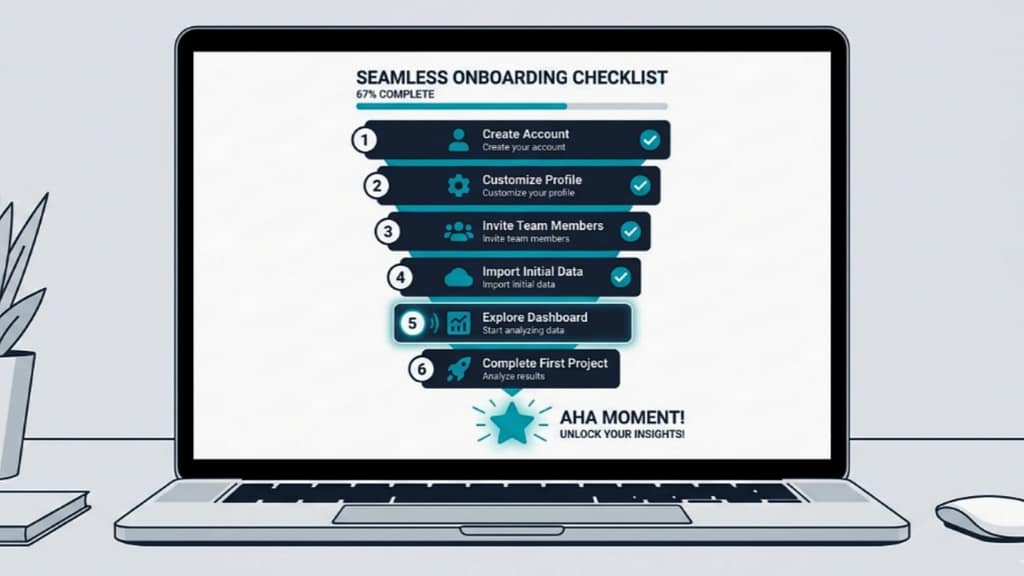

🎯 Short Answer
The best onboarding checklist for SaaS startups follows six sequential stages: remove signup friction, segment users by goal, accelerate first value (within five minutes), send a triggered rescue email if they stall (within ten minutes), guide them through an in-app milestone checklist, and monitor low-activity accounts for early personal outreach. This framework is built directly from what founders and customer-success operators on r/SaaS, r/CustomerSuccess, r/startups, and r/EntrepreneurRideAlong report actually moving the needle on activation and churn in 2025–2026 — not from generic advice.
The Onboarding Paradox Killing Early-Stage SaaS in 2026
You have already done the hard part. You found the channel, wrote the copy, and paid to bring a user through the door. And then — nothing. They signed up, clicked around for ninety seconds, and disappeared before ever reaching the moment your product was built for.
Across r/SaaS, r/CustomerSuccess, r/startups, and r/EntrepreneurRideAlong, this is the single most emotionally charged complaint from founders in 2025–2026: wasted acquisition effort. Founders feel they are paying to bring users in, only to lose them before activation. The fix is almost never a new acquisition channel. It is fixing what happens in the first ten minutes after signup. If you are still spending on paid growth before solving your onboarding, read our breakdown of why ad-driven SaaS scaling without a retention foundation bleeds cash.
What the community data makes clear is that users are not asking for a perfect checklist. They want to reach value fast — with no confusion about what to do next, no long forms, and no feature-dump tours. The vocabulary that keeps surfacing in these threads is consistent: “streamline the signup process,” “minimize obstacles,” “time to first value,” “drop off,” and “aha moment.” Those phrases are not buzzwords. They are the exact words of founders who either solved the problem or are still bleeding over it.
This article gives you the complete six-stage onboarding checklist that maps directly to what is actually working in the field right now — verified against community discussions from 2025–2026. No made-up metrics. No theory borrowed from a decade-old SaaS playbook.
The SaaS Onboarding Funnel: Six Activation Stages at a Glance
Before drilling into each step, here is how the entire framework stacks up — from signup all the way to long-term retention. Each stage maps to a concrete community-backed tactic.
Why SaaS Onboarding Keeps Failing: The Real Pain Points
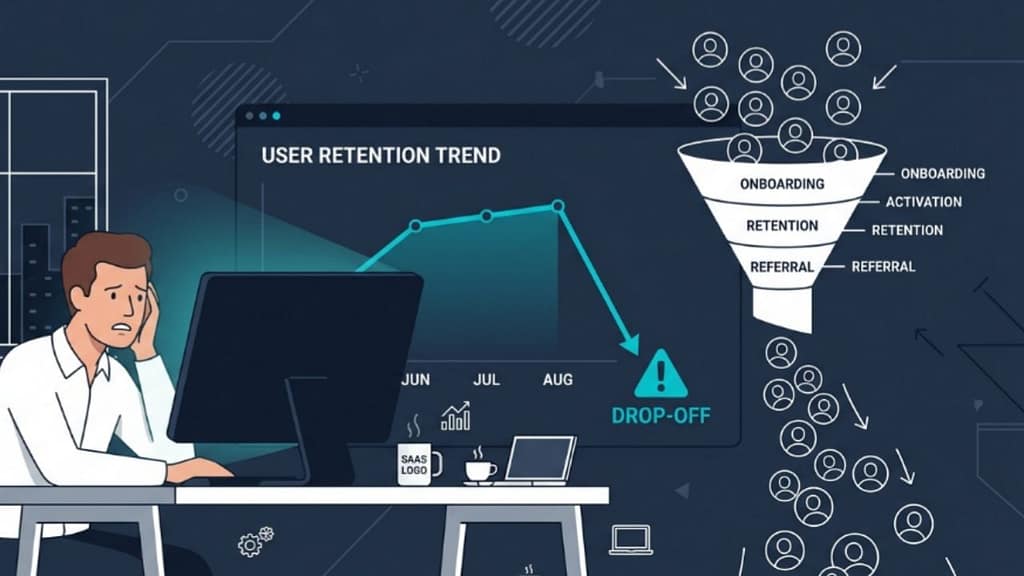
The communities that surfaced the sharpest onboarding intelligence — r/SaaS (activation and retention tactics), r/CustomerSuccess (handoff process pain), r/startups (founder-level product rollout), and r/EntrepreneurRideAlong (launch checklists) — share a pattern of recurring failure points. Knowing exactly where users fall off is the prerequisite to fixing it.
| Pain Point | Community Source | What Founders Actually Said | Proven Fix |
|---|---|---|---|
| Too much signup friction | r/SaaS, r/startups | “streamline the signup process,” “minimize obstacles” | One action per step; request only the minimum data needed |
| Weak first-run guidance | r/SaaS, r/CustomerSuccess | “drop off after signup unless a trigger happens quickly” | Pre-load sample data within the first five minutes of signup |
| Generic, goal-agnostic onboarding | All four communities | Users dislike onboarding that doesn’t match their goal | “What do you want to accomplish?” with three-route segmentation |
| Poor sales-to-onboarding handoff | r/CustomerSuccess | “keep B2B onboarding without chaos” | Shared milestone roadmap; define responsibilities at the outset |
| Users disappearing before “aha” moment | r/SaaS, r/CustomerSuccess | “time to first value,” “time to onboarding” | Behaviour-triggered email within ten minutes of drop-off |
| Silent churn from low-activity accounts | r/CustomerSuccess | “reduce churn by contacting low-activity accounts early” | Personal (non-template) outreach; not waiting for monthly reviews |
Notice that every pain point above is a process failure, not a product failure. The product is often fine. The sequence that surrounds it is broken. Fixing the sequence — which is what this checklist does — is one of the highest-leverage moves available to an early-stage founder.
“The theme is frustration with wasted acquisition effort: founders feel they are paying to bring users in, only to lose them before activation.”
— Aggregated insight, r/SaaS + r/CustomerSuccess community discussions, 2025–2026
If you are still diagnosing whether this is a product problem or a discovery problem, our guide on how to find SaaS pain points on Reddit and build what people actually need will help you separate signal from noise before you invest further in onboarding infrastructure.

The 6-Step SaaS Onboarding Checklist: A Stage-by-Stage Action Plan
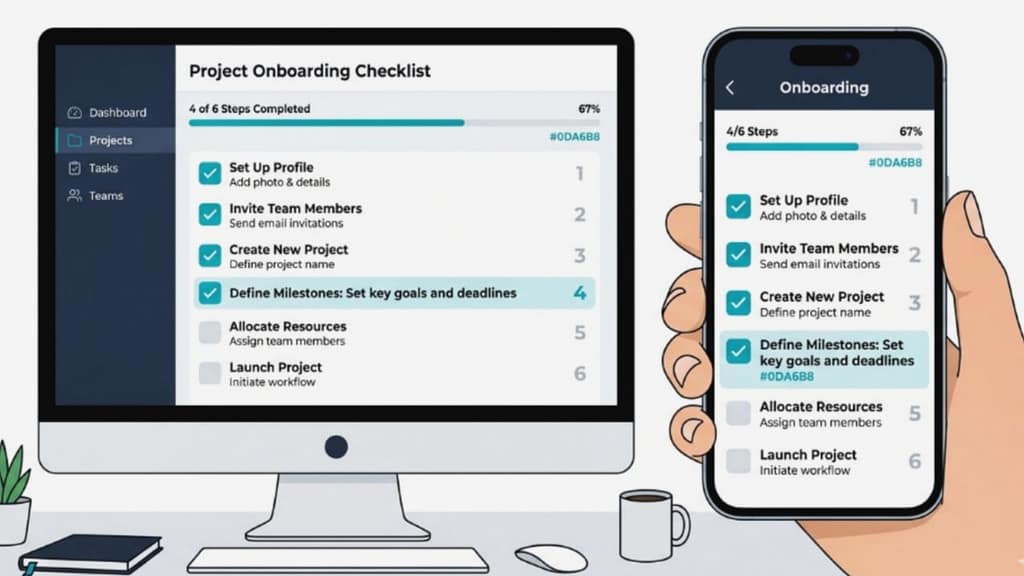
Here is the complete checklist, stage by stage. Each step includes the specific community-validated tactic and what it is designed to do. Work through these in order — the stages are interdependent.
✅ Stage 1: Remove Signup Friction
The goal: get the user from landing page to inside the product with as few steps — and as little cognitive load — as possible.
The clearest instruction to come out of the community discussions is this: ask for one action at a time. That means entering an email, setting a password, or connecting an API credential — never all at once on a single form. Requesting the minimum data needed is not a UX nicety; it is the difference between a user completing signup and a user closing the tab.
- Reduce the signup form to email and password only at entry.
- Defer company size, job title, and billing information to post-activation.
- Remove any mandatory email-verification wall before the user sees the product for the first time.
- Set up social login (Google / GitHub) as an alternative to reduce typing friction.
The “one action per step” rule also applies to your product’s initial setup flow — if you need API credentials or integration details, introduce that as Step 1 of the in-app checklist, not as a prerequisite to entering the product at all.
✅ Stage 2: Goal-Based Segmentation (Three-Route Method)
The goal: route every user into a tailored onboarding flow that matches their actual job-to-be-done — before they encounter a single feature.
The most consistently recommended tactic across the r/SaaS and r/CustomerSuccess threads is to ask one qualifying question immediately after the signup step is complete. Not on the landing page. Not in a welcome email. Inside the product, as the very first screen they see.
Ask one qualifying question after signup: “What do you want to accomplish?” — and route users into a tailored flow based on their answer.
— Community-backed tactic, r/SaaS + r/CustomerSuccess, 2025–2026
The implementation detail that surfaced repeatedly in the threads: use three radio-button options — not a dropdown, not a free-text field, not six options. Three choices is the practical sweet spot between personalisation and decision fatigue. Each option then determines which version of the in-app checklist a user sees, which tooltips fire, and which email sequence they enter.
- Display the “What do you want to accomplish?” screen as the first post-login view.
- Offer exactly three radio-button options that map to your core use cases.
- Each option should trigger a different in-app checklist and a different email sequence.
- Store the selected goal to personalise all downstream touchpoints — including follow-up calls.
Segmentation is also the right moment to capture the user’s use case for your AI-driven acquisition and activation workflows — knowing which persona just entered your product is the prerequisite for personalising every automated step that follows.
✅ Stage 3: First-Value Acceleration — The Five-Minute Rule
The goal: make the user feel the product’s value within the first five minutes of being inside it — before they have done any real setup work themselves.
This is the strongest hidden-gem tactic to emerge from the customer-success discussions: instead of making new users build everything from scratch, pre-load the product with sample or near-complete data. Show them a nearly-finished setup so that their first experience is “oh, I can see what this does” rather than staring at an empty canvas wondering where to start.
The “pre-loaded data within the initial five minutes” idea is a concrete activation shortcut: instead of making users build everything themselves, show them a nearly-finished setup so they can feel the product’s value immediately.
— r/CustomerSuccess community insight, 2025–2026
- Pre-populate the product with realistic sample data relevant to the user’s selected goal (from Stage 2).
- Avoid blank-state dashboards on first login — they communicate nothing and create abandonment.
- Show a single “quick win” action the user can complete in under two minutes (e.g., invite a teammate, connect one integration, or publish one item).
- Time-to-first-value should be a tracked product metric, not just a design aspiration.
Avoid the trap of building this feature and then procrastinating on shipping it. If you are over-optimising the sample data setup instead of getting it in front of real users, read our note on how productive procrastination is quietly killing SaaS products.
✅ Stage 4: Triggered Rescue Messaging — The Ten-Minute Rule
The goal: catch users who stall or drop off during onboarding before they mentally cancel and never return.
Community discussions are unusually specific here: the recommended triggered follow-up window is within ten minutes of detected inactivity or drop-off — not after a day, not after a week, not on the following Monday. The ten-minute window reflects a behavioural reality: users who stall are still mentally present. They have not yet moved to another product. A timely, relevant message can bring them back. A message sent twenty-four hours later usually cannot.
The full onboarding email sequence that community practitioners recommend has five layers:
- Welcome email — immediate; confirms signup and reiterates the single next action.
- Milestone / success-action email — triggered when a user completes a key setup step.
- Feature highlight email — introduces one relevant feature based on the user’s stated goal.
- Reminder email — triggered if a user has not completed a milestone within a defined window.
- Soft upsell email — sent near the end of the onboarding sequence, when the user has demonstrated engagement.
- Set up behaviour-triggered email automation tied to in-app event data (not just time-based drips).
- The rescue email should reference the exact step where the user stopped — not a generic “come back” message.
- Keep each email to one call-to-action that returns the user to the specific incomplete task.
- Never deploy the soft upsell (email 5) before the user has completed the core activation event.
✅ Stage 5: In-App Checklist + B2B Milestone Roadmap
The goal: give every user (and every B2B account’s stakeholders) a clear, shared view of what “fully onboarded” looks like, and who is responsible for each step.
For self-serve / PLG products, a concise in-app checklist is the primary scaffold. It should show no more than five to seven items, with each item representing a single meaningful action — not a vague capability. Completing the checklist should feel like an achievement, not like filling out a compliance form.
For B2B / sales-assisted products, the community discussion on r/CustomerSuccess is emphatic: the checklist is not enough on its own. What removes onboarding chaos in B2B is a shared milestone roadmap that does three things from day one:
- Defines each milestone clearly with benchmark timelines.
- Assigns a named owner (customer-side and vendor-side) for each task.
- Schedules a follow-up call at the very start of the onboarding relationship — not as a reactive check-in.
For the tooling side of this — building and delivering the milestone roadmap efficiently without adding more tools to your stack — see our round-up of time-saving tools in 2026 that reclaim 100+ hours for solo founders.
- Self-serve: in-app checklist capped at five to seven items; each item = one action.
- B2B: build the shared milestone roadmap inside a tool both sides can see (Notion, Google Sheets, or a CSP platform).
- Schedule the first follow-up call at the moment of signing — do not wait until a milestone is missed.
- Include benchmark timelines for each milestone so both parties have a shared definition of “on track.”
✅ Stage 6: Low-Activity Intervention and Retention Monitoring
The goal: identify accounts that have gone quiet before they churn, and recover them with personal — not automated — outreach.
This is the stage with the most concrete proof point in the entire research brief. One founder on r/CustomerSuccess described being stuck at $1.5k MRR with churn that would not move. Their fix was not a new feature. It was not a new pricing tier. It was this: monitoring low-activity accounts and sending personal emails rather than templates. Churn fell to under 7%.
One founder reduced churn to under 7% after being stuck at $1.5k MRR. The fix was monitoring low-activity accounts and sending personal emails rather than templates.
— r/CustomerSuccess community discussion, 2025
The word “personal” is doing significant work in that sentence. Template emails get ignored. A message that references the user’s specific account activity — “I noticed you set up your workspace but haven’t connected your first integration yet — can I help?” — gets opened and replied to.
- Define “low-activity” for your product (e.g., no login in 7 days after activation, or no core action completed in 5 days).
- Set up a daily alert or dashboard view showing accounts below that activity threshold.
- Write outreach emails that reference the user’s specific account state — not a generic “we miss you.”
- Treat every personal outreach as a product research opportunity: ask what got in the way.
- Combine Stage 6 monitoring with the email sequence from Stage 4 — they are complementary, not redundant.
If this feels like too much to handle alongside building the product, the underlying issue might be scope — see our battle-tested lessons on how to build and ship SaaS products that survive the early stages for a practical prioritisation framework.
E-E-A-T Summary: Best Practices at a Glance
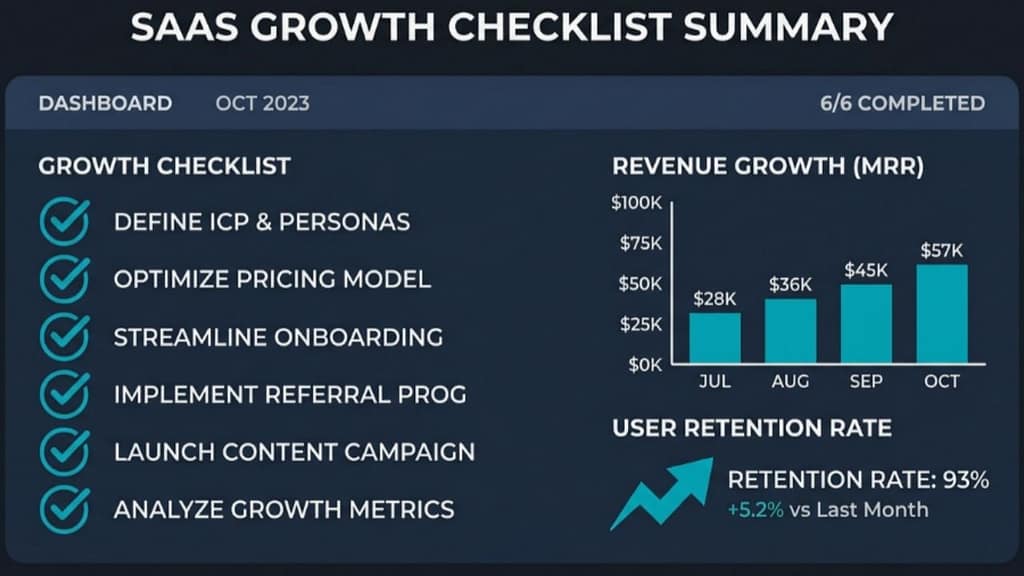
Every recommendation in this checklist is grounded in practitioner-reported outcomes from 2025–2026 community discussions — not industry benchmarks from SaaS vendors with a product to sell. Here is the complete reference table.
| # | Best Practice | What It Directly Addresses | Community Source | Applies To |
|---|---|---|---|---|
| 1 | One action per step throughout signup and setup | Signup friction and form abandonment | r/SaaS, r/startups | All SaaS |
| 2 | “What do you want to accomplish?” with three-route segmentation | Generic onboarding; goal mismatch | r/SaaS, r/CustomerSuccess | All SaaS |
| 3 | Pre-loaded sample data within the first five minutes | Empty-state abandonment; delayed aha moment | r/CustomerSuccess | All SaaS |
| 4 | Behaviour-triggered rescue email within ten minutes of drop-off | Silent stalls after signup; lost activated users | r/SaaS, r/CustomerSuccess | All SaaS |
| 5 | Five-stage email sequence: welcome → milestone → feature → reminder → soft upsell | Unstructured email drips; premature upsells | r/startups, r/SaaS | All SaaS |
| 6 | In-app checklist (≤7 items) + B2B shared milestone roadmap | Onboarding chaos; unclear next steps | r/CustomerSuccess, r/EntrepreneurRideAlong | PLG + B2B |
| 7 | Personal (non-template) low-activity outreach | Silent churn; accounts going dark before cancelling | r/CustomerSuccess | All SaaS |
These are not the seven things you eventually get to. They are the seven things that are actively separating founders who are compounding MRR from those who are re-acquiring users they already paid to bring in. If you want a wider view of what etxecution-first SaaS building looks like across more dimensions, see 10 battle-tested lessons from building and killing 15 SaaS products.
Frequently Asked Questions
What should a SaaS onboarding checklist include?
A SaaS onboarding checklist should cover six core areas: signup friction removal (minimum required fields, one action per step), goal-based segmentation (a single qualifying question with three tailored paths), first-value acceleration (pre-loaded sample data within five minutes), triggered rescue messaging (a behaviour-triggered email within ten minutes of stall), milestone completion (an in-app checklist of five to seven meaningful actions), and low-activity monitoring (personal outreach to accounts showing early signs of disengagement). These six stages emerged consistently across r/SaaS, r/CustomerSuccess, r/startups, and r/EntrepreneurRideAlong in 2025–2026.
How do you create an onboarding checklist for a SaaS startup?
Start by mapping where users currently drop off — not by theorising. Use product analytics to identify the last meaningful action before the majority of users disappear, then assign a checklist stage to that specific moment. Build backwards from your product’s core activation event (the action that most predicts long-term retention), and design every checklist step to move the user toward that event. Prioritise simplicity over completeness: community discussions are consistent that a five-to-seven-item checklist that users actually complete is far more valuable than a twenty-item checklist that no one finishes.
What are the key onboarding steps for new users?
Based on the 2025–2026 community evidence, the key steps in order are: (1) complete signup with minimum friction, (2) answer one goal-segmentation question with three options, (3) experience the product’s core value within the first five minutes via pre-loaded data, (4) receive a triggered follow-up if they stall within ten minutes, (5) work through a concise in-app checklist, and (6) receive personal outreach if their activity drops below a defined threshold. The sequence is designed so that each step reinforces the next.
How long should SaaS onboarding take?
Community practitioners frame this as a “time to first value” question rather than a total onboarding duration question. The goal is to deliver the product’s core value experience within the first five minutes of signup — the pre-loaded data approach described in Stage 3 is specifically designed to compress that window. Full onboarding (completing the milestone checklist and reaching the activation event) will vary by product complexity, but the principle is consistent: every extra minute between signup and aha moment increases the probability of permanent drop-off.
Which onboarding tasks most directly reduce churn?
The two tasks with the most direct churn impact based on community data are: (1) triggered rescue emails sent within ten minutes of drop-off, which prevent first-day abandonment from becoming permanent; and (2) personal outreach to low-activity accounts, which catches at-risk users before they cancel. The concrete proof point in the research brief: one founder reduced churn to under 7% specifically by shifting from template-based outreach to personalised, account-state-specific emails sent to low-activity users. Both tasks are human-level retention moves, not just automation plays.
Should SaaS onboarding be automated or manual?
Both — at different stages. Signup, segmentation, in-app checklists, and the triggered email sequence (Stages 1–5) should all be automated. The automation exists to ensure consistent delivery at scale and to catch every drop-off event regardless of your team’s capacity. Manual intervention becomes essential at Stage 6: low-activity outreach is most effective when it is personalised to the specific user’s account state. The community evidence is clear that template-based re-engagement emails do not produce the same results as messages written to a specific user’s situation. For early-stage startups, even a partially automated system with manual Stage 6 intervention has been shown to significantly reduce churn.
What does a SaaS onboarding email sequence look like?
The five-layer sequence recommended across the community discussions runs as follows: a welcome email sent immediately after signup confirming the next single action; a milestone email triggered when the user completes a core setup step; a feature highlight email introducing one relevant capability based on the user’s stated goal; a reminder email triggered if a milestone has not been completed within a defined window; and a soft upsell email deployed near the end of the sequence once the user has demonstrated genuine engagement. Each email should carry exactly one call-to-action and reference the user’s specific onboarding context.
What onboarding KPIs should SaaS startups track?
Based on the practitioner vocabulary that surfaced most consistently in the research communities, the core onboarding KPIs are: time to first value (how long from signup to the user’s first meaningful product interaction), activation rate (the percentage of signups who complete the core activation event), checklist completion rate (the percentage of users who finish the in-app onboarding checklist), triggered email engagement rate (opens and click-throughs on the rescue and milestone sequence), and churn rate by cohort (tracking whether onboarding improvements reduce churn across successive signup cohorts). These five metrics map directly to the six stages of the onboarding framework.
What is an onboarding checklist for enterprise customers?
Enterprise onboarding extends the B2B milestone roadmap model from Stage 5 with additional stakeholder and technical layers. The r/CustomerSuccess discussions highlight three requirements specific to enterprise contexts: a shared milestone roadmap visible to both the vendor and the customer’s internal champions, defined ownership of each task on both sides (vendor CSM and customer project lead), and a scheduled follow-up cadence built into the onboarding contract from day one — not a reactive check-in triggered by escalations. Technical setup checklists (SSO configuration, API key provisioning, data migration) should be attached as a separate track within the same roadmap rather than treated as prerequisites to the relationship starting.
How do you design first-time user experience (FTUE) for SaaS?
FTUE design for SaaS should be built around three principles from the community evidence: show value before asking for effort (pre-loaded data; no blank-canvas first screen), personalise before you guide (ask the goal-segmentation question before presenting any checklist or tooltip), and rescue fast (trigger a rescue email within ten minutes of stall rather than relying on the user to return on their own). Practically, this means the FTUE flow should be: signup form → one goal question (three options) → pre-loaded product view → single “quick win” action → in-app checklist. Feature tours, onboarding videos, and capability walkthroughs are secondary to getting the user to their first meaningful outcome.