


The Short Answer
To survive and thrive during difficult market periods, founders must decouple daily volatility from long-term strategy. The core founder mindset habits for tough times center on implementing a “weather vs. climate” model, prioritizing daily discipline over sporadic motivation, and validating with manual-first execution before investing resources into product building.
Introduction: The 1 A.M. Reality of the Modern Founder
If you are a startup founder, you already know the emotional weight of building in a tough environment. It is the silent pressure of 2 AM doubts, feeling lonely, dealing with harsh reviews, facing sudden client loss, or waking up to unexpected server malfunctions. In those moments, it is incredibly easy to make reactive, panic-driven decisions that can jeopardize months of hard work.
As we explored in our deep-dive on how to find SaaS pain points on Reddit, founders in active communities like r/Entrepreneur and r/TheFounders repeatedly describe their raw, unvarnished emotional loads. They describe feeling burnout, isolation, intense self-doubt, and the persistent sense that “no one is coming to rescue them.”
To survive these hard seasons, successful founders do not rely on heroism. Instead, they manage their psychological state with the exact same rigor they apply to managing a corporate P&L. They treat burnout as a matter of leadership maturity, shifting their focus from emotional volatility to systematic execution.
Founder Execution Benchmarks: Successful Validation vs. Over-Building
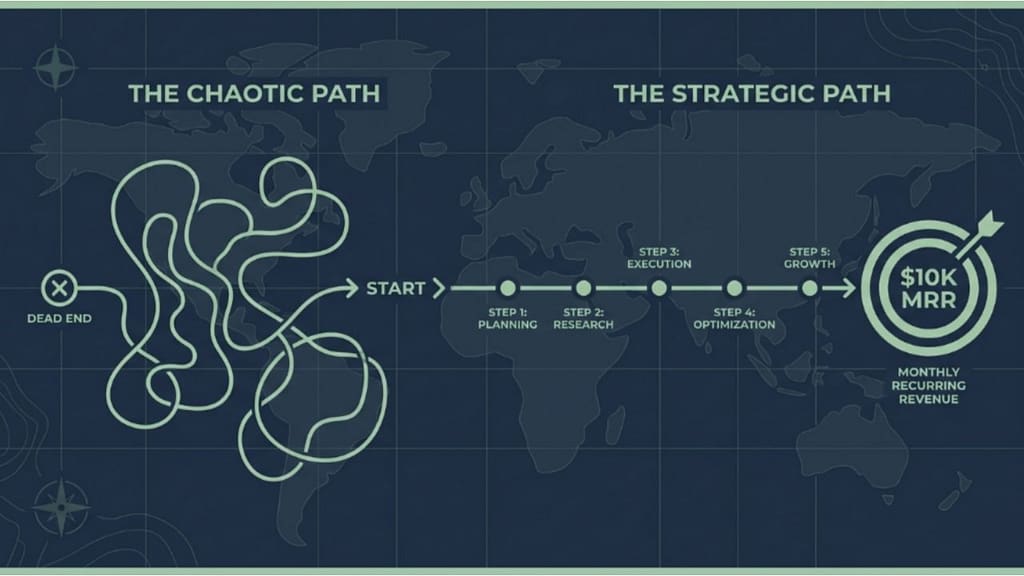
Caption: Real-world data contrasts founders who spend 4–6 months building in isolation against those who execute manual-first validation to reach $10K MRR.
1. Real-World Founder Pain Points
To understand how to navigate tough times, we must first look at the real-world operational and emotional patterns that cause startups to fail. Across founder-adjacent communities, three distinct themes consistently emerge:
- The “Dead or Saved” Emotional Swing: Founders under pressure warn against extreme emotional volatility. On one good day, the business feels completely saved; on one bad day, it feels completely dead. This dynamic fuels reactive, short-sighted adjustments.
- Strategic Overwhelm and “Motion” vs. Progress: When things get tough, founders frequently confuse activity with progress. They worry about scaling too early, hiring too soon, and losing their grip on core metrics. They adopt a “move fast” execution style but completely skip the critical “think slow” decision-making process.
- The Validation Trap: A recurring, painful trend is the high operational cost of poor validation choices. Many teams spend 4 to 6 months building in isolation, launch once on Product Hunt, and then find themselves wondering why nothing happened. This isolation is a classic symptom of productive procrastination—it feels like progress, but it is ultimately deadly.
“Burnout is tied to leadership maturity, not heroism. You must manage your psychology with the same rigor you manage your P&L.”

2. The Action Playbook: Habits of Mindset-Driven Founders
How do successful founders stay calm and keep making correct moves when everything seems to go wrong? They build daily, repeatable habits that separate external stress from internal strategy.
Habit 1: Apply the “Weather vs. Climate” Model
The strongest community advice for maintaining mental toughness is to differentiate daily setbacks from long-term strategy. Think of daily events as the weather: harsh reviews, client loss, server malfunctions, or 2 AM doubts are temporary storms.
Your mission, culture, and core product offering are the climate. You must never make permanent, climate-level strategic decisions based on short-term weather pain. When a daily setback hits, acknowledge it as weather and focus on preserving your long-term judgment.
Habit 2: Choose Discipline Over Motivation
Motivation is highly volatile and highly unreliable in hard seasons. Resilient founders establish a routine of repeating a few boring, high-impact actions daily. This includes:
- Asking for objective feedback instead of defensively explaining away critique.
- Treating customer rejection as vital market research rather than a personal referendum on their self-worth.
- Focusing entirely on “thinking slow” when making decisions while tired, preventing reactive mistakes.
Habit 3: Work ON the Business, Not IN It
When pressure mounts, the instinctive reaction is to dive into the codebase or get buried in administrative tasks. Real resilience requires delegating early, utilizing ready-made templates and boilerplate code instead of rebuilding everything, and doing tasks manually until the workflow is verified enough to automate.
By leveraging the right frameworks and time-saving tools, you can reclaim hours spent on administrative tasks and focus entirely on strategic growth.
Habit 4: Execute a Manual-First Validation Sprint
Instead of spending months building in a vacuum, successful founders run pre-mortems and think of time as their core currency. Data from interviews with over 300+ founders shows that the winning teams validate their concepts with 20+ customer interviews first, launch across 20+ directories in weeks 5–6, and in some cases reach $10K MRR in just 3–5 months by maintaining a manual-first execution strategy.
This matches our foundational analysis on how to success a SaaS, where validating market demand always triumphs over isolated engineering.
3. Comparison: Reactive vs. Mindset-Driven Execution
The following table contrasts the operational outcomes of reactive execution against disciplined, mindset-driven habits based on real-world community benchmarks:
| Operational Focus | Reactive Execution (Isolated Model) | Mindset-Driven Execution (Winner Model) |
|---|---|---|
| Initial Validation | Spent 4–6 months building in isolation | Conducted 20+ qualitative customer interviews |
| Launch Strategy | Launched once on Product Hunt | Launched across 20+ directories in weeks 5–6 |
| Handling 2 AM Doubts | Reactive pivots based on emotional swings | Decoupled weather (setbacks) from climate (strategy) |
| Daily Action Plan | Chasing motivation; busywork and over-building | Boring, repeatable daily discipline |
| Time to Market Traction | 0 traction, strategic overwhelm, high burn rate | Reached $10K MRR in 3–5 months in some cases |
4. Frequently Asked Questions
How do founders stay motivated during tough times?
Resilient founders do not rely on motivation, which is highly volatile. Instead, they focus on discipline over motivation by repeating a small set of boring, high-impact daily actions. They treat time as a currency, using pre-mortems to navigate uncertainty calmly.
What habits help founders handle stress?
The most effective habit is the “weather vs. climate” model. This habit teaches founders to view daily setbacks (like client loss or bad reviews) as temporary weather, ensuring they do not make permanent, climate-level strategic changes based on short-term pain.
How do successful founders deal with burnout?
Successful founders recognize that burnout is tied to leadership maturity rather than heroism. They manage their mental energy with the same strictness as a P&L. They work *on* the business rather than getting buried *in* it—delegating early, utilizing boilerplates, and doing tasks manually before attempting automation.
What mindset do founders need to survive hard seasons?
Founders need a highly analytical, manual-first validation mindset. They avoid the trap of spending 4–6 months building in isolation. Instead, they prioritize talking directly to target customers, validating demand through 20+ interviews, and launching broadly across multiple directories early on.
How do founders stay resilient when revenue drops or everything goes wrong?
They manage fear and uncertainty by treating customer rejection purely as market research rather than a personal failure. They focus heavily on maintaining decision hygiene, avoiding busywork, and refusing to confuse rapid motion with actual progress.
Need tactical support as you scale? Check out our complete roadmap on Scaling SaaS With Ads to learn how to drive sustainable growth without burning out your team.




Pingback: How to Build Founder Resilience Under Pressure: 2026 Guide - Klyzed