

✦ SHORT ANSWER
To build founder resilience under pressure, treat it as an operational system, not a mindset hack. Run the G.R.O.W. Check (map Gaps, set Routines, build Outside Mirrors, embed Well-being Buffers), execute a survival-first pivot before you burn out, and install measurable KPIs — like 2–4 decision-free blocks per week and monthly peer check-ins — to make recovery non-negotiable. According to founder community data from 2025–2026, 54% of founders experienced burnout and 49% considered quitting — proof that willpower alone will not save you.
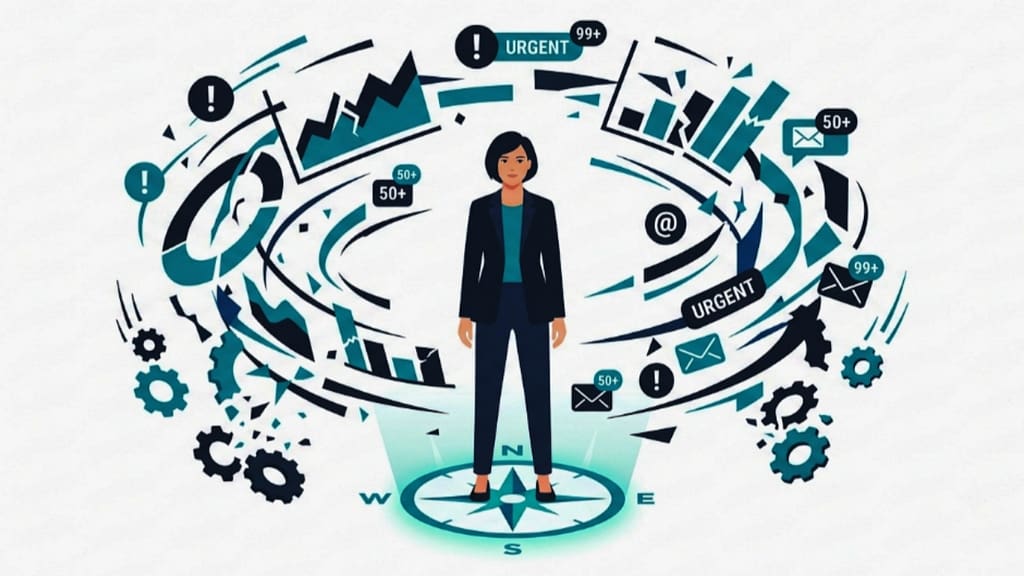
There is a phrase that shows up again and again in founder community threads on r/startups, r/Entrepreneur, and Indie Hackers: “I’m drowning in growth — everything’s breaking, including me.” It sounds dramatic until you realize that founder community surveys from 2025–2026 back it up with hard numbers. 75% of founders say entrepreneurship has taken a toll on their mental health. Not some. Three out of four.
The conversation in these communities goes deeper than burnout surface-talk. Founders describe “exhaustion that rest won’t solve” — a cognitive and decision fatigue that sits below the physical layer. They talk about identity fusion with the business (“if the startup fails, I fail”), shame that prevents early help-seeking (“don’t want to show weakness”), and the silent anxiety of sudden scale: “If 10× users arrived tomorrow, where would I crack?”
Here is the strategic reality: founders who adopted disciplined cost-control and operational resilience practices improved their survival odds measurably. PwC global insolvency research found that startup insolvencies dropped approximately 4.9% in 2025 versus 2024, with disciplined operational resilience cited as a key driver. Resilience is not a personality trait — it is a system. And in this guide, you will build yours.
The Founder Mental Health Data You Can’t Ignore in 2026
Founder community surveys and LinkedIn workshop summaries from 2025–2026 surface three headline numbers. Taken together, they define the baseline crisis every solo builder is operating inside of right now:
“54% of founders experienced burnout in 2025, and 49% considered quitting.” These are not edge cases. They are the median founder experience — and they are the baseline you are building your resilience system against.
Founder community surveys & LinkedIn workshop summaries, 2025–2026
The 4 Pressure Points That Break Founders (And Why Willpower Won’t Fix Them)
Before you can build resilience, you need to name the specific failure modes. Active founder communities in 2025–2026 identified four recurring pressure points — each one representing a distinct category of founder breakdown that operational systems, not positive thinking, must address.
| Pressure Point | How Founders Describe It | Root Cause | What Actually Breaks |
|---|---|---|---|
| Scaling Collapse | “Everything’s breaking, including me” | Mental load, not just hours worked | Decision quality and system clarity |
| Identity Fusion | “I considered quitting” / “I’m not sure I can keep doing this” | Founder identity fused with company outcome | Long-term commitment and mental stability |
| Cognitive Fatigue | “Sleep doesn’t fix this” / “exhaustion that rest won’t solve” | Decision fatigue, not physical tiredness | Executive function and judgment |
| Shame & Isolation | “Don’t want to show weakness” / “wearing burnout as a badge” | Social stigma around founder vulnerability | Early help-seeking and peer support access |
Notice that three of the four root causes are structural, not psychological. Scaling collapse comes from system gaps — not weakness. Cognitive fatigue comes from decision overload — not laziness. Shame and isolation come from cultural norms — not personal failure. This means the fix is also structural. That is exactly what the G.R.O.W. Check is designed to do.

The G.R.O.W. Check: Your Tactical Resilience Readiness Audit
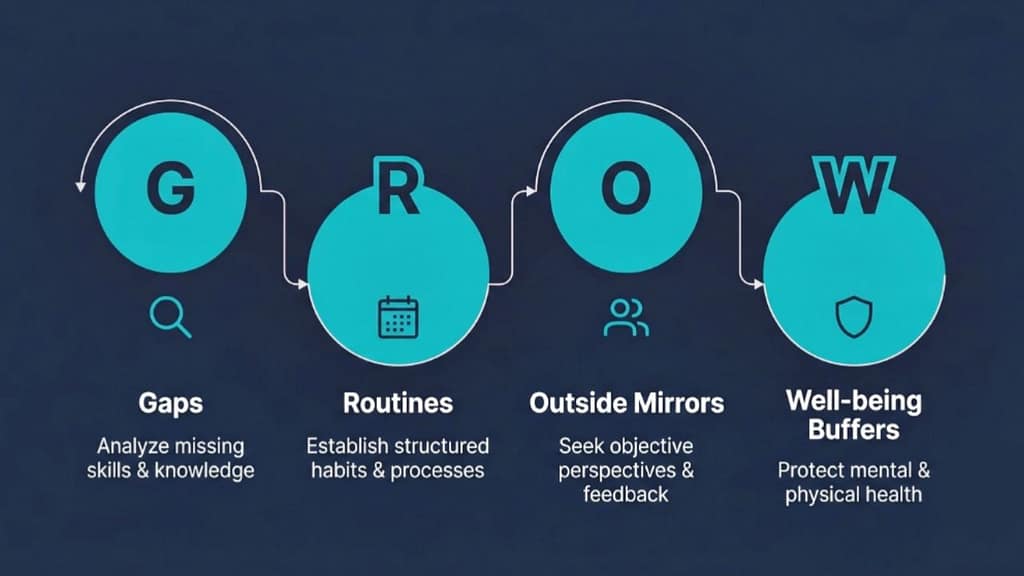
The G.R.O.W. Check is a community-coined framework that emerged from active founder discussions across LinkedIn, Indie Hackers, and startup forums throughout 2025–2026. Founders who applied it reported that it surfaced predictable failure points before a crisis arrived and measurably improved decision clarity under pressure. Run this audit before you are under pressure — it operates as a pre-mortem for your operational resilience, not a crisis response protocol.
Gaps
Audit your current systems: Where are your single points of failure? What breaks if you are unavailable for 72 hours? Map the gaps — in cash reserves, ops infrastructure, communications, and hiring pipeline — before they map you. Use the founder mindset survival playbook to structure this audit.
Routines
Install rule-based operating rhythms that protect cognitive load: decision-free blocks (2–4 per week), no product changes on Fridays, and a weekly review cadence. Routines remove micro-decisions before they accumulate into fatigue. Building self-discipline under discomfort is the foundation that makes routines stick.
Outside Mirrors
Recruit honest external perspectives: peer founder groups, mentors, coaches, or structured accountability pods. Community data confirms recurring peer groups with honest one-word check-ins function as low-cost early warning systems. Your mirrors catch what your blind spots miss — a critical resilience input you cannot source internally.
Well-being Buffers
Protected rest, intentional slack, and non-negotiable recovery routines — embedded as company KPIs, not optional perks. Community practitioners recommended tracking sleep hours per week and unplug hours alongside revenue metrics. If it is not measured, it will not survive a growth sprint.
Founders who ran the G.R.O.W. Check before a crisis hit reported that it surfaced predictable failure points and improved decision clarity — not because it was complex, but because it forced specificity on exactly where and how their system would crack first.
Founder community discussions, Indie Hackers & LinkedIn, 2025–2026
When Growth Breaks You: The Survival-First Pivot Playbook
Multiple founders in r/startups and Indie Hackers shared a counterintuitive lesson from their crisis moments: stopping the chase for growth saved their company. The survival-first pivot is not a failure — it is a strategic decompression that buys back your most critical resource: time. Community-shared timelines show that focused pivots typically stabilized businesses within 1–3 months, with some founders recovering runway from as low as 4 months to a recovered 9–12 months after the pivot.
The Three Decisions That Define a Survival Pivot
Mental Health as Ops: KPIs, Rituals, and Decision-Free Blocks
LinkedIn workshop posts and practitioner-led founder groups from 2025–2026 made a striking recommendation: embed mental health inputs as company-level KPIs, not personal commitments. The reasoning is tactical — personal commitments get cut when growth pressure spikes. Company KPIs survive because they are tracked, reviewed, and accountable. This approach to dopamine management for entrepreneurs is what separates founders who burn out from those who compound performance over time.
Operational Resilience KPIs (Community-Validated)
| KPI | What It Measures | Community-Recommended Target | Review Cadence |
|---|---|---|---|
| Decision-Free Blocks | Cognitive load management | 2–4 blocks per week | Weekly |
| Protected Sleep Hours | Physical resilience baseline | Tracked weekly total | Weekly |
| Peer Check-ins | External accountability & perspective | 1× per month minimum | Monthly |
| Daily Self-Reflection | Early signal detection | 3-question journal or voice note | Daily |
| Unplug Hours | Recovery capacity | Tracked alongside revenue | Weekly |
These are not aspirational wellness targets. They are operational inputs — the equivalent of tracking uptime and response latency in a software system. Improving your brain performance and focus is directly tied to how consistently you protect and measure these inputs. The founders who treat them as KPIs are the same founders who avoided the “49% considered quitting” statistic.
The 10× Arrival Test: Find Your Breaking Points Before Growth Does
One of the most consistently referenced founder community exercises from 2025–2026 is the tabletop “10× Arrival Test” — a structured pre-mortem that forces your leadership team to answer a single terrifying question: if 10× users arrived tomorrow, where exactly would we crack? Run this exercise quarterly with your team (or alone, if you are a solo founder). It mirrors the community-tested practice of pre-mortem thinking and surfaces fragility before it becomes a crisis with a price tag.
⬡ THE 10× ARRIVAL TEST — 8 QUESTIONS TO RUN WITH YOUR TEAM
- Cash & Runway: If 10× users arrived and infrastructure costs scaled proportionally, how many months of runway would we have left?
- Ops Infrastructure: Which operational system would fail first — support volume, deployment pipeline, or database capacity?
- Communications: Which internal communication system would collapse under 10× volume? Who becomes the single point of failure?
- Hiring Pipeline: What single hire would become critical in the first 30 days of 10× scale, and do we have a shortlist ready?
- Product Burden: Which three features would generate the most support tickets under 10× user load?
- Onboarding: At which step in our current onboarding flow would conversion collapse at scale?
- Team Capacity: Who on the team would hit their personal limit first, and what is the warning signal we would see before it happens?
- Crisis Protocol: If three of the above failures happened simultaneously, what is our 48-hour response protocol — and is it written down?
The power of this exercise is not in finding perfect answers — it is in identifying which questions you cannot answer. Every unanswered question is a gap in your resilience map that your G.R.O.W. Check should address. Founders who could not answer questions 3, 7, and 8 consistently reported those as the exact vectors where their pressure crisis hit hardest.
E-E-A-T Summary: Founder Resilience Best Practices (2026)
Every tactic in this guide is grounded in lived founder experience from 2025–2026 community discussions, corroborated by PwC global insolvency research, LinkedIn workshop summaries, and practitioner-shared operational metrics. This table consolidates the evidence trail:
| Practice | Community-Validated KPI | Expected Outcome | Source |
|---|---|---|---|
| G.R.O.W. Check Audit | Monthly audit score (pass/fail per pillar) | Surfaces failure points before crisis | Founder community, 2025–2026 |
| Decision-Free Blocks | 2–4 blocks per week | Reduced cognitive fatigue, better judgment | Community KPI data, 2025–2026 |
| Peer Founder Groups | 1× monthly structured check-in | External perspective, early warning signals | Indie Hackers, LinkedIn, 2025–2026 |
| Survival-First Pivot | Runway stabilization in 1–3 months | 4 months → 9–12 months recovered runway | r/startups, founder community, 2025 |
| 10× Arrival Test | Quarterly tabletop exercise | Identified single points of failure pre-crisis | r/Entrepreneur, Founder communities, 2025 |
| Disciplined Cost-Control | Insolvency rate reduction | ~4.9% drop in startup insolvencies (2025 vs 2024) | PwC global insolvency research, 2025 |
Frequently Asked Questions
What exactly is founder resilience and why does it matter more in 2026?
Founder resilience is the operational capacity to maintain sound judgment, make effective decisions, and sustain forward momentum during extended periods of high-pressure uncertainty — without burning out or breaking your company’s systems in the process. It matters more in 2026 because the data shows the baseline has gotten harder: 75% of founders report a mental health toll, 54% experienced burnout in 2025 alone, and solo founders increasingly carry the cognitive load of multiple roles simultaneously. Resilience is not optional at this baseline — it is a survival prerequisite.
How long does it take to recover from founder burnout once it hits?
Based on community-shared timelines from 2025, founders who executed a focused survival-first pivot after hitting burnout typically stabilized their business and personal operating capacity within 1–3 months. The key accelerant was narrowing scope aggressively (cutting to one paying segment, fixing churn) rather than trying to recover energy while maintaining the same operational surface area. Recovery is faster when you reduce cognitive load before you try to rebuild capacity. The founders who tried to power through without changing their system consistently reported longer and more damaging recovery timelines.
What are the best measurable KPIs for tracking founder resilience?
Community practitioners from 2025–2026 recommended three core categories of measurable resilience inputs: cognitive load KPIs (decision-free blocks: 2–4 per week), physical baseline KPIs (protected sleep hours tracked weekly), and accountability KPIs (structured peer check-ins at a minimum of once per month). These are tracked alongside business metrics — not separately as personal wellness goals — to ensure they survive growth pressure. Add the quarterly 10× Arrival Test score as a systems-level resilience metric to complete your tracking stack.
How do I build a peer founder support system that actually gives honest feedback?
Community data from Indie Hackers and LinkedIn founder groups points to three design principles for an effective peer system: keep it small (3–5 founders at similar stages), use structured formats (a one-word check-in at the start of each session removes social performance pressure and surfaces real states), and create explicit permission for hard conversations (pre-agreed norms that make challenge normal rather than exceptional). Peer groups that lack these design elements drift toward social validation rather than honest accountability — which defeats their entire resilience function. Combine your peer group with the G.R.O.W. Check “Outside Mirrors” pillar for maximum leverage.
✦ BOTTOM LINE
Resilience is the system you build before the pressure arrives — not the heroism you perform after it does.
Run the G.R.O.W. Check this week. Schedule your first 10× Arrival Test for next month. And if you have been wearing burnout as a badge — now is the time to build the operational floor that means you never have to again. Explore the full founder mindset survival playbook for the complete framework.