
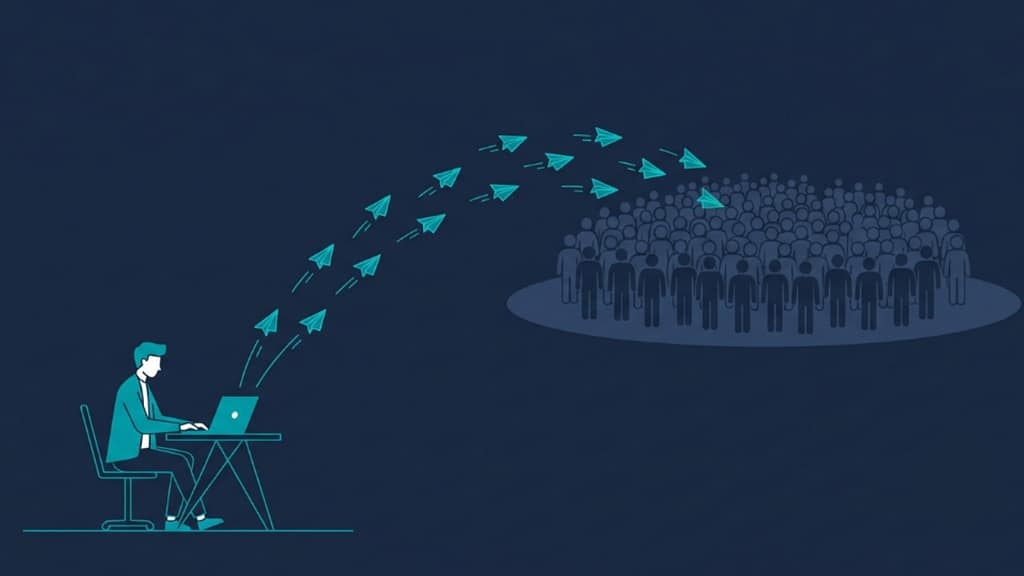

Short answer: Most solo SaaS founders get their first 100 customers through manual outreach, warm-network introductions, and genuine participation in communities like Reddit, LinkedIn, and Indie Hackers — not paid ads or viral moments. The founders who move fastest interview real prospects before building more, then run a disciplined outreach system instead of a single “growth hack.”
If your CRM is still empty and you’re refreshing your analytics dashboard hoping for a spike, here’s the reality every founder who’s actually done this will tell you: the first 100 customers come from relentless, manual, no-BS outreach — not a clever tweet or a lucky feature. There’s no shortcut where you write one great landing page and customers show up. You have to go find them, one conversation at a time.
By the end of this guide, you’ll have a repeatable system for landing your first customers: how to validate before you build more, how to mine the network you already have, where your buyers are already hanging out online, and what a realistic daily outreach cadence looks like — all grounded in what founders who’ve actually hit this milestone report doing.
Where One Founder’s First 100 Customers Actually Came From
Before the step-by-step, it’s worth seeing what a real breakdown looks like. A 2026 Indie Hackers post broke down exactly where a founder’s first 100 signups came from — and launch platforms alone accounted for over a third of them.
That 38% is real, but notice what it implies: the majority — 62 of the first 100 — still came from somewhere else entirely. That “somewhere else” is what the rest of this guide is about: warm networks, manual outreach, and community participation.
The Real Pain Points Founders Hit Before Customer #1
Before the tactics, it helps to name what’s actually making this hard. These are the recurring frustrations founders describe when they’re stuck at zero.
| Pain Point | What Founders Say | Why It Matters |
|---|---|---|
| “100 feels impossible” | Founders repeatedly call this the hardest early milestone, often described in “no-BS, relentless, manual outreach” terms rather than a one-click hack. | Sets unrealistic expectations that a single tactic will get you there. |
| Generic advice doesn’t apply | A recurring frustration is generic growth advice that assumes you already have a brand, an audience, or social proof. | You need tactics built for zero-audience SaaS, not for scaling an existing base. |
| Going too broad, too early | Hacker News commenters stress that targeting broad, horizontal segments early makes acquisition significantly harder. | A narrow niche gives you a specific place to find and message people. |
| 100 might be the wrong first target | Several founders argue 100 is too ambitious as a starting point — get your first 5–10 customers and learn from them first. | Reframes the goal from a vanity number to a learning loop. |

The Step-by-Step Plan to Get Your First 100 SaaS Customers
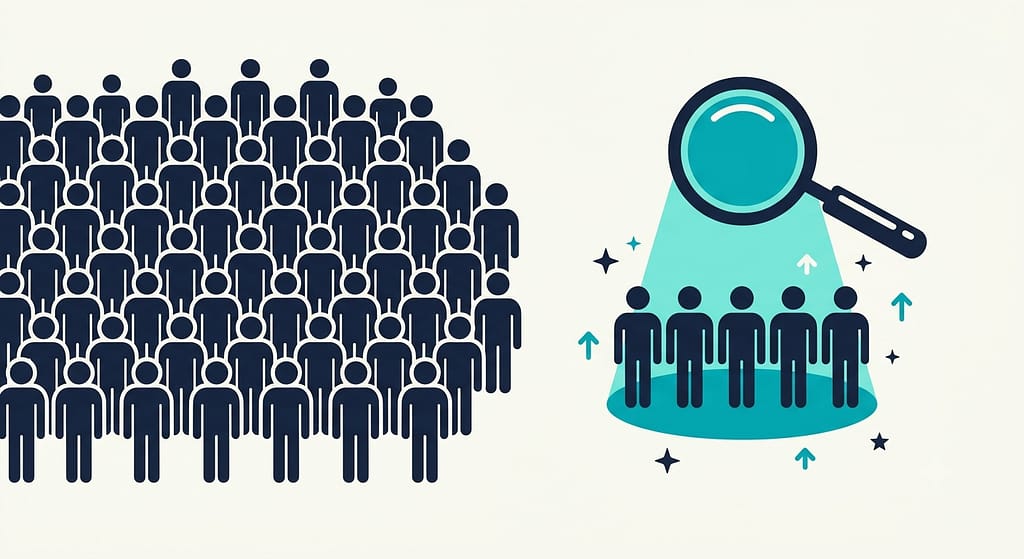
Step 1: Interview 10 People Before You Build Anything Else
In one Hacker News discussion, a founder described reaching 60+ paying customers in under two months by interviewing 10 people first, shipping a genuinely simple MVP, and then marketing directly inside the communities where those people already spent time. The interviews came before the marketing, not after.
This lines up with basic customer-development thinking: you talk to real prospects before you scale outreach, so the messaging you send later actually matches how they describe their own problem.
Step 2: Get Your First 5–10 Before You Chase 100
A 2026 Hacker News thread made a specific case: treating 100 as the opening target is too ambitious. Instead, get your first 5–10 customers, learn from them, and only then commit to a volume-based outreach cadence.
The same thread recommended that once you’ve validated with your first handful of users, you move to at least 50 manual outreaches per day — individually, not in a blast.
Step 3: Mine Your Warm Network First
Before you touch a single stranger’s inbox, work outward from people who already know you: friends, family, school contacts, and LinkedIn connections. Then ask them for introductions to people who actually have the problem you solve.
The specific phrasing matters here. Instead of a vague “do you know anyone who might need this?”, ask directly: “who are two or three people you’d recommend I talk to?” That framing is repeatedly described as far more effective at actually producing a warm intro than a generic ask.
Step 4: Build a Prospect List and Do 50 Manual Outreaches a Day
Manual outbound is the most consistently repeated answer across founder discussions: build a real prospect list, contact people individually, and open with a request for a conversation — not a pitch. For account-based prospecting, founders point to tools like LinkedIn Sales Navigator, Kaspr, and Lusha for finding and contacting the right people, and BuiltWith-style market lists for identifying companies likely to already use a competing or adjacent tool.
Step 5: Show Up Where Your Buyers Already Hang Out
Community-led distribution is a recurring theme in how founders describe their early traction: real participation on r/SaaS, r/SaaSSales, r/microsaas, Indie Hackers, and Hacker News — not ads run against those audiences.
One Reddit user said their SEO-focused SaaS got its first 90 loyal customers by tapping their own network and showing up in the communities where their target audience already hung out. Another Reddit thread claimed the 5th through 10th customers came directly from commenting under other people’s posts — with the anecdotal rule of thumb that one solid Reddit post should generate at least one customer (treat that as a loose signal, not a guarantee).
Step 6: Layer In Launch Platforms and Content — After You’ve Validated
Content and SEO are described as a compounding channel — but usually only after direct outreach has already clarified the offer and the target audience. A founder on r/SaaSSales said their first 100+ customers came from a mix of existing network outreach, LinkedIn prospecting, content, referrals, and partnerships — not any single channel. Layered on top of that, launch platforms like Product Hunt and startup directories are exactly the channels that produced the 38% jump shown in the chart above.
Why This Works: The E-E-A-T Behind the Advice
This isn’t theory. It’s what founders on Indie Hackers, Hacker News, and Reddit’s SaaS communities report actually doing — and it lines up with the academic research on why early-stage software startups struggle in the first place. An arXiv study on decision-making in early-stage software startups highlights how resource constraints and market uncertainty shape what founders can realistically test and learn in these first months. A separate 2017 study on why early-stage software startups fail points to the gap between strategy and execution — specifically, the risk of prioritizing product-building over actually learning from the market — as a core failure pattern.
| Practice | Why It Works |
|---|---|
| Interview before you build more | Aligns messaging and product with real prospect language — the pattern behind one founder’s 60+ customers in under two months. |
| Target 5–10 before 100 | Turns an intimidating vanity number into a learning loop you can actually complete. |
| Ask for “2–3 people,” not “anyone” | A specific ask produces real warm introductions far more often than a generic one. |
| 50 manual outreaches/day | Matches the volume-based cadence founders describe using once they’ve validated their offer. |
| Participate in niche communities | Reddit and Indie Hackers threads repeatedly credit real participation — not ads — for early customers. |
FAQ: Getting Your First 100 SaaS Customers
How long does it take to get your first 100 SaaS customers?
It varies widely, but founders in these discussions report reaching meaningful early traction — 60+ paying customers, or 90 loyal customers — within roughly two to a few months, once they moved from validation into a disciplined outreach cadence.
Should I focus on ads or manual outreach first?
Manual outreach first. It’s the most consistently repeated answer across founder discussions, and it’s what clarifies your offer and audience enough for content, SEO, and paid channels to work later.
How many outreach messages should I send per day?
Once you’ve validated with your first 5–10 customers, aim for at least 50 individual, manual outreaches a day — not a single blast to a purchased list.
What if I don’t have much of a network to tap into?
Start with the communities your buyers already use — Reddit, Indie Hackers, Hacker News, and relevant LinkedIn groups — and participate genuinely before you pitch. Several founders report their earliest customers coming directly from comments and conversations in these spaces, not from their existing contacts.
Get your first 5–10 customers before you chase 100. Then do 50 manual outreaches a day. That’s the whole playbook — no growth hack required.
Related reading on Klyzed: our full SaaS customer acquisition strategy for 2026, a solo-developer marketing system for growing your app alone, how to find SaaS pain points on Reddit, picking a profitable, narrow SaaS niche, and a real SaaS launch playbook.