
⚡ Short Answer
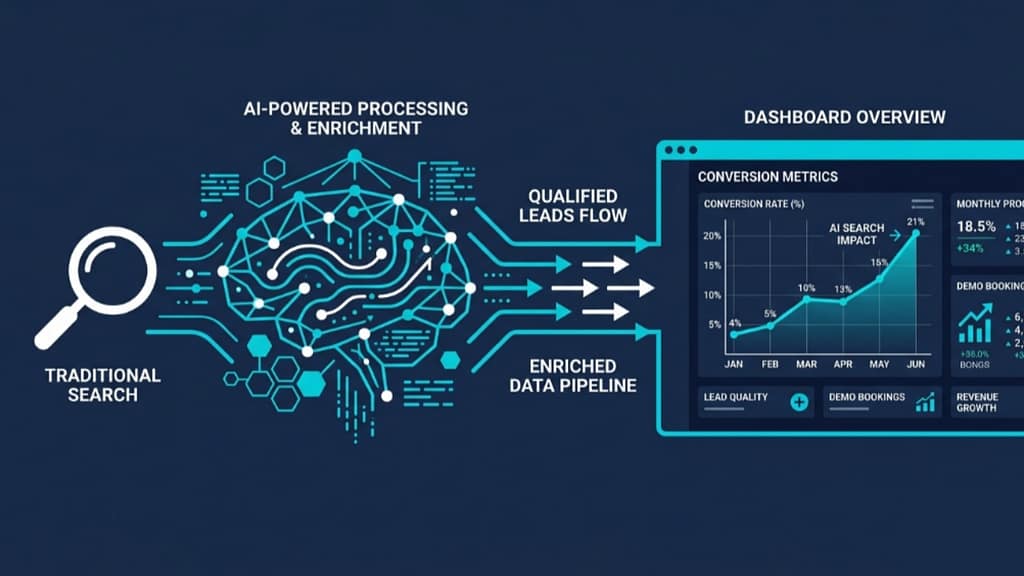
AI SEO for B2B SaaS is the practice of structuring your content, pages, and off-site presence so that AI-powered tools — ChatGPT, Perplexity, and Google AI Overviews — extract, cite, and recommend your brand when buyers research solutions. It goes beyond keyword rankings; your pages need to be answer-first, machine-readable, and citation-worthy. According to a 2026 B2B SEO report, AI search traffic converts at 14.2% compared to Google organic’s 2.8% — making AI citation the highest-leverage organic growth channel available to B2B SaaS founders right now.
The AI Search Disruption Every B2B SaaS Founder Needs to Know
Here’s the uncomfortable reality: your buyers aren’t starting their SaaS research on Google anymore.
They’re opening ChatGPT, running queries in Perplexity, scanning Reddit threads, and reading Quora answers — all before they’ve visited a single vendor website. By the time they reach your pricing page, they’ve already formed an opinion shaped entirely by which tools AI systems chose to cite. If your brand wasn’t among them, you lost that deal before the demo request was ever submitted.
The data backs this up. According to a 2026 B2B SEO report, 71.7% of all searches now trigger AI Overviews, and 26.4% of niche B2B SaaS SERPs specifically surface AI-generated answer boxes at the top. That’s not a trend worth monitoring. That’s a structural shift in how B2B discovery works — and it’s already here.
Practitioners in Reddit’s r/SaaS and r/SEO are blunt about what’s happening: the March 2026 core update has been systematically crushing generic, AI-generated blog content, and teams still running vanity-traffic SEO are watching rankings fall while pipeline stays flat. The frustration is universal — “we’re doing content, but we’re not seeing demos or trials.”
This playbook is for founders and growth leaders who want pipeline, not pageviews. If you’ve ever wondered how to appear in ChatGPT when a buyer searches “best [your category] software,” read this alongside How to Get Users Using ChatGPT: The Founder’s Playbook for AI-Driven Signups — the two strategies compound each other significantly.
Why AI-Referred Traffic Converts at 5× the Rate of Google Organic
Before the tactics, understand the opportunity size. The conversion gap between AI-referred traffic and traditional organic isn’t marginal — it’s transformational.
Conversion Rate by Traffic Source — 2026 B2B SaaS
Source: 2026 B2B SEO report & practitioner community datasets (r/SaaS, r/SEO, Quora)
A 2026 B2B SEO report confirms that AI search traffic converts at 14.2% versus Google organic’s 2.8%. A separate practitioner data source places AI-referral traffic converting 3 to 5 times better than classic organic across multiple B2B SaaS verticals. The mechanism is straightforward: a buyer who arrives via AI citation has already received a qualified endorsement. The AI system evaluated your content, trusted it, and recommended it to someone actively researching the problem you solve. That visitor isn’t browsing — they’re validating.
Off-site platforms show meaningful lift too. Practitioner datasets cite 4.8% conversion from Quora and 3.6% from Reddit — both well above Google organic, and both increasingly powerful because AI tools like ChatGPT and Perplexity actively index these community discussions when forming answers.
“The future belongs to SaaS teams who build pages both humans and AI can trust.” — Community practitioner consensus, r/SaaS & r/SEO, 2026
Why Your Current SEO Strategy Is Failing in the AI Era
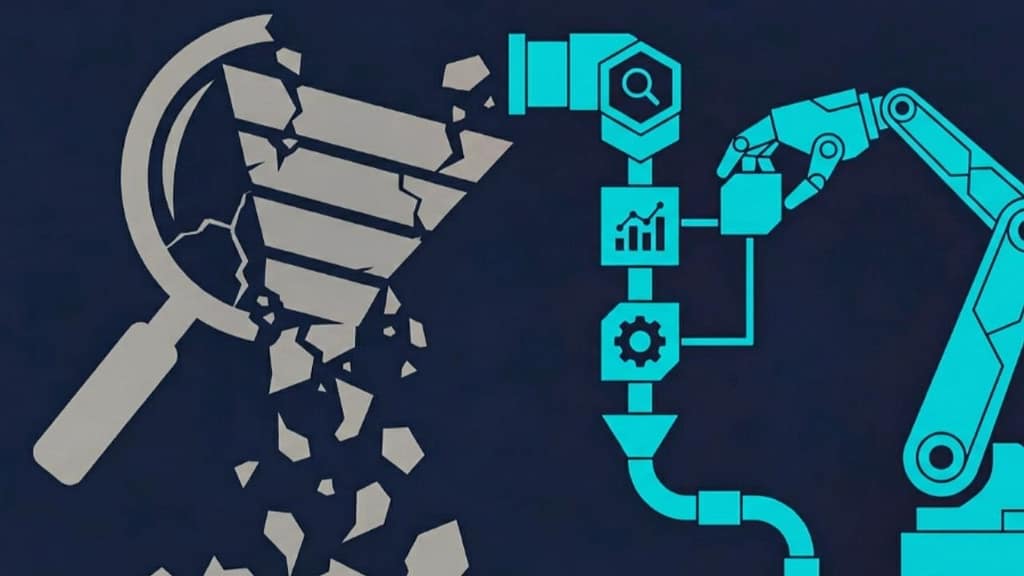
Reddit’s r/SaaS threads are filled with frustrated founders right now. The recurring complaint: producing content, ranking for keywords, and still not seeing demos or trials. The problem isn’t output volume — it’s structural architecture. There are four specific failure modes killing B2B SaaS SEO in 2026:
| Failure Mode | What’s Happening | AI SEO Consequence |
|---|---|---|
| Generic AI-Written Content | Thin posts with no original data, no perspective, no verified outcomes | Penalized by the March 2026 core update; AI systems skip uncited, low-trust content |
| Rankings Without Conversion | Traffic-focused TOFU content with no path to demo or trial | AI systems prioritize BOFU pages; informational-only content generates zero pipeline |
| Bloated, Unreadable Pages | Heavy JavaScript, interstitial pop-ups, hidden pricing, poor HTML structure | AI agents skip structurally broken pages entirely — no extraction means no citation |
| Zero Off-Site Presence | No Quora answers, no Reddit contributions, no community validation signals | Buyers validate vendors on Reddit and Quora before visiting sites; absence signals distrust to AI systems |
The deepest issue is structural. AI agents scan pages looking for clean, extractable answers. When they encounter a JavaScript rendering wall, a content-blocking pop-up, or a pricing page that reads “contact us for a quote,” they move on to a competitor whose page they can actually parse. Practitioner feedback from r/SEO makes this starkly clear: hidden pricing and bloated HTML are hard stops for AI agent crawlers.
This isn’t about publishing more content. It’s about publishing smarter-structured content that both humans and AI systems can trust, extract from, and cite. For a broader look at how misallocated effort kills SaaS growth before it compounds, see: Productive Procrastination Is Killing Your SaaS.


clean pages, BOFU assets, and strategic off-site presence.
The 5-Step AI SEO Action Plan: Get Cited, Not Just Ranked
AI SEO for B2B SaaS isn’t about gaming a new algorithm. It’s about becoming the most trustworthy, most extractable answer to the questions your buyers are actively asking AI tools. Here’s the concrete action plan built from verified practitioner data.
Step 1: Switch to Answer-First Content Architecture
The highest-impact structural change you can make today is restructuring every article to deliver the core answer in the first 2–3 sentences — before any context, backstory, or company framing. Practitioners call this “citation optimization,” and it is the primary reason some pages get extracted by AI systems while identical-length competitors do not.
The implementation is straightforward: add a bolded Short Answer block at the top of every post (modeled on the block at the top of this article). Write every H2 and H3 heading as the exact question a buyer would type into Perplexity or ChatGPT. Include at least one verified statistic per major section. Replace generic advice with specific outcomes, named sources, and real case references.
AI systems scan for pages that answer queries directly with verifiable information. If your first 100 words are an intro about your company’s journey, you’ve lost the citation competition before it started. Answer first, expand second — always.
Step 2: Build the BOFU Content Stack That Actually Drives Demos
The practitioner consensus from r/SaaS and r/SEO in 2026 is unambiguous on this: BOFU (Bottom of Funnel) pages are simultaneously the most likely to convert visitors and the most likely to appear in AI-assisted buyer research. If your content calendar is 90% thought leadership and 10% BOFU, you’re building an audience — not a pipeline.
The four BOFU page types that perform best in AI search visibility:
- Comparison pages — “[Your Tool] vs [Competitor]” with a clear data-backed verdict and structured comparison table. These answer the highest-intent buyer query that exists.
- Alternatives pages — “Best [Category] Alternatives in 2026” with honest pros, cons, and use-case fit for each option. High AI citation rate because the query maps 1:1 to buyer research behavior.
- Transparent pricing pages — Publish real numbers. Hidden or “contact us” pricing is a hard stop for AI agents. Pages that show actual tiers, seat costs, and annual discounts get cited; pages that don’t, don’t.
- Use-case pages — “[Your Tool] for [Specific Role or Industry]” with outcome-based proof points. These appear when buyers query AI tools with role-specific software questions.
These pages work because AI systems pull them to answer the exact queries buyers submit right before a purchase decision — “what’s the best alternative to [X],” “how much does [category software] cost,” “best [tool] for [industry].” Identifying those queries starts with understanding your buyers’ real pain points. A useful companion read: How to Find SaaS Pain Points on Reddit and Build What People Need.
Step 3: Build Clean, Machine-Readable Pages AI Agents Can Actually Crawl
Every page on your SaaS site needs to pass what practitioners call the “AI agent test”: can a crawler extract the core information cleanly, without hitting JavaScript blockers, interstitial pop-ups, or content locked behind forms? If it can’t, you don’t exist in AI search — regardless of your Domain Authority or backlink profile.
| Technical Element | What to Implement | Priority |
|---|---|---|
| FAQPage Schema | Structured Q&A markup on every key page — directly extractable Q&A pairs for AI | 🔴 Critical |
| Article Schema | Author, datePublished, dateModified, and publisher on all blog content | 🔴 Critical |
| SoftwareApplication Schema | Product category, pricing, features on your features/pricing pages | 🔴 Critical |
| llms.txt File | Plain-language product description at /llms.txt — a README for AI agent crawlers | 🟡 High |
| Markdown Mirror Pages | Clean /markdown versions of key product and comparison pages for LLM extraction | 🟡 High |
| Transparent Pricing | Publish real pricing tiers — “contact us” pages are invisible to AI agents | 🔴 Critical |
| Clean HTML Structure | Minimal client-side JS rendering, no content-blocking interstitials or pop-ups | 🔴 Critical |
The llms.txt file is particularly worth implementing now, while adoption is still low. It’s a simple plain-text file at your domain root that describes your product, your audience, and your core capabilities — essentially a README for AI systems. Early-mover advantage here is real: AI agents actively parsing llms.txt files are prioritizing those products in citation recommendations.
Step 4: Win Off-Site AI Visibility Through Reddit and Quora
Here’s the insight most B2B SaaS teams miss entirely: AI systems don’t only cite your website. They cite wherever credible, relevant discussions about your category exist — and that includes Reddit threads, Quora answers, and community comment sections. Practitioner datasets record Quora converting at 4.8% and Reddit at 3.6% for B2B SaaS — both significantly above Google organic, and both with compounding citation value as AI tools increasingly surface community content.
This creates two distinct advantages for AI SEO. First, your Quora answers and Reddit contributions can appear directly in AI search responses, giving you citation presence even when your domain isn’t ranking for the underlying keyword. Second, a brand appearing consistently in high-quality community discussions signals credibility to AI evaluation systems — the same systems deciding which vendors to recommend.
The practical approach: identify the top 10-15 questions in your category on Quora and write the most specific, data-backed answer for each — the kind of answer that would make a practitioner bookmark it. On Reddit, prioritize r/SaaS and the subreddits where your buyers congregate. Contribute genuine technical value first, category experience second, and product mention only when organically relevant. Promotional content gets flagged immediately; useful answers earn upvotes, visibility, and AI indexing.
“Quora and Reddit can surface in AI responses even when the brand site itself does not — making off-site community presence a direct AI SEO lever, not just a traffic play.” — Practitioner discussion, r/SaaS & r/SEO
Step 5: Measure AI Citation — Not Just Organic Traffic
Traditional SEO dashboards — keyword rankings, impressions, organic sessions — are structurally incomplete measures of AI SEO performance. If Google Search Console is your only measurement lens, you’re missing the majority of the value you’re generating (and the majority of the pipeline you’re losing to competitors).
What to track for AI SEO in 2026:
- AI citation tracking — manually query ChatGPT, Perplexity, and Gemini weekly using your top 10–15 buyer questions. Log which vendors get cited, when your brand appears, and what content is referenced. This is your AI search ranking equivalent.
- Direct + branded search trends — AI-referred visitors frequently show as direct traffic. Track spikes in direct sessions and branded search volume correlated with citation activity as a proxy signal.
- BOFU page conversion rates — measure demo requests, trial signups, and contact form completions from comparison pages, alternatives pages, and pricing pages specifically. These are your highest-ROI AI SEO assets.
- Referral traffic from Quora and Reddit — this should be steadily growing as your off-site community presence compounds. Flat or declining referral traffic here means your community strategy needs attention.
Teams winning at AI SEO in 2026 treat citation tracking as a first-class KPI alongside keyword rankings. If no AI tool cites your brand when a buyer asks “best [category] software,” that’s not a brand awareness problem — it’s a pipeline architecture problem. See also: Scaling SaaS With Ads: The B2B Founder’s Profitable Growth Playbook and How to Success a SaaS: 10 Battle-Tested Lessons From Building (and Killing) 15 Products for how AI SEO fits into a broader growth architecture.
AI SEO for B2B SaaS: Best Practices Summary
Here’s the consolidated playbook. These are the eight practices that separate B2B SaaS teams generating measurable pipeline from AI search, from teams generating impressions that never convert:
| Best Practice | How to Implement | Expected Outcome |
|---|---|---|
| Answer-First Structure | Short Answer block at top of every post; H2/H3 headings written as exact buyer questions | Higher AI citation rate; eligibility for Google AI Overviews |
| BOFU Content Priority | Publish comparison, alternatives, pricing, and use-case pages with real data and clear verdicts | Direct demo and trial pipeline from high-intent AI-referred traffic |
| FAQPage Schema | Structured Q&A markup on every key page — pre-parsed Q&A pairs for AI extraction | AI Overviews eligibility; structured data extraction without page parsing |
| llms.txt File | Plain-language product + audience description at /llms.txt for AI agent crawlers | Improved AI agent comprehension; early-mover citation priority |
| Transparent Pricing | Publish real pricing tiers — remove all “contact us for pricing” gating | Pages become AI-crawlable; cited in “how much does X cost” AI queries |
| Clean Page Architecture | Minimize client-side JS rendering, remove content-blocking pop-ups, simplify HTML | Full AI agent crawlability; no skipped or invisible pages |
| Off-Site Community Presence | Active Quora answers + genuine Reddit contributions in your category subreddits | 4.8% Quora / 3.6% Reddit conversion lift; AI citation off-site when domain isn’t ranking |
| AI Citation Tracking | Weekly manual checks in ChatGPT / Perplexity / Gemini for your 10–15 core buyer queries | Real-time AI search visibility; competitive citation intelligence |
For the productivity tools that help a solo founder or small team execute this strategy without burning out, see: Time-Saving Tools 2026 – Reclaim 100 Hours.
Frequently Asked Questions: AI SEO for B2B SaaS
What is AI SEO for B2B SaaS?
AI SEO for B2B SaaS is the practice of optimizing your website, content, and off-site presence so that AI-powered search engines — including ChatGPT, Perplexity, Google AI Overviews, and Gemini — surface and cite your brand when B2B buyers research software solutions. It extends traditional SEO by adding citation worthiness, answer-first content structure, machine-readable page architecture, and community-validated credibility signals. According to a 2026 B2B SEO report, AI Overviews now appear on 71.7% of all searches and on 26.4% of niche B2B SaaS SERPs specifically.
How is AI SEO different from traditional B2B SEO?
Traditional B2B SEO optimizes for keyword positions in Google’s blue-link results, measured by rank, impressions, and organic sessions. AI SEO optimizes for citation in AI-generated answers — measured by whether your brand appears when AI tools respond to buyer queries. The structural difference: AI SEO requires answer-first content architecture, structured schema markup, clean machine-readable HTML, off-site community presence on platforms like Reddit and Quora, and BOFU pages (comparisons, alternatives, pricing) that AI systems extract to answer high-intent buyer queries. Traditional rankings alone no longer predict citation presence.
How do B2B SaaS companies get cited by AI tools?
Getting cited by AI tools requires: (1) publishing answer-first content with verified statistics and specific outcomes per section; (2) implementing FAQPage, Article, and SoftwareApplication schema markup; (3) building BOFU pages — comparison, alternatives, pricing, and use-case pages — that AI systems pull to answer purchase-intent queries; (4) maintaining a clean, machine-readable site without JavaScript rendering blocks, pop-ups, or hidden pricing; (5) adding an /llms.txt file at your domain root describing your product in plain language for AI agent crawlers; and (6) maintaining an active, value-first presence on Quora and Reddit, where AI systems also source answers for community-validated queries.
Which pages work best for AI SEO in SaaS?
BOFU pages consistently outperform informational content in AI search citation rates. The four highest-performing page types are: comparison pages (“[Your Tool] vs [Competitor]”), alternatives pages (“Best [Category] Alternatives in 2026”), pricing pages with transparent published numbers, and use-case pages targeting specific buyer roles or industries. These pages map directly to the high-intent queries buyers submit to AI tools right before a purchase decision — which is why the r/SaaS and r/SEO practitioner community consistently prioritizes them over top-of-funnel content in 2026 AI SEO strategies.
What schema should a B2B SaaS site use for AI SEO?
The highest-priority schema types for B2B SaaS AI SEO are: FAQPage (on any page with Q&A structure — gives AI systems pre-parsed question-and-answer pairs), Article (on blog posts and guides — includes author, datePublished, and dateModified for E-E-A-T signals), SoftwareApplication (on product and pricing pages — category, pricing, feature descriptions), and Organization (on homepage and About page — name, URL, logo, social profiles). FAQPage schema is the single highest-leverage implementation because it delivers pre-structured Q&A directly to AI extraction systems without requiring them to parse surrounding prose.
How do you measure AI SEO success?
AI SEO success is measured through five signals: (1) AI citation tracking — weekly manual queries in ChatGPT, Perplexity, and Gemini for your core buyer questions, logging which vendors get cited and when your brand appears; (2) BOFU page conversion rates — demo requests and trial signups from comparison, pricing, and alternatives pages; (3) direct and branded search growth — AI-referred visitors frequently show as direct traffic; (4) referral traffic from Quora and Reddit; and (5) overall pipeline-to-organic correlation. Given that a 2026 B2B SEO report documents AI search traffic converting at 14.2% versus Google organic’s 2.8%, conversion rate is the most meaningful success signal — not rankings or impressions alone.
Does AI SEO replace traditional SEO for SaaS?
No — AI SEO is a new distribution layer built on top of traditional SEO, not a replacement for it. Technical SEO fundamentals (crawlability, page speed, clean HTML, backlink authority, on-page optimization) remain the essential foundation. AI SEO adds citation optimization, machine readability, BOFU content prioritization, off-site community presence, and AI-specific technical elements like llms.txt and markdown mirrors. The practitioner consensus from r/SaaS and r/SEO in 2026: teams treating AI SEO as a separate parallel channel lose to teams who integrate both into a unified content and technical strategy.
What content format is best for AI search visibility?
The highest-performing format for AI search citation combines: a direct Short Answer block at the top answering the core query in 2–3 sentences, H2/H3 headings structured as exact buyer questions rather than creative titles, at least one verified statistic per major section, structured comparison tables for multi-option topics, an FAQ block with FAQPage schema at the bottom, and minimal prose padding around the substantive content. This format is engineered for extractability — AI systems can pull direct answers without needing to interpret narrative context. According to practitioner feedback from the r/SEO and r/SaaS communities, this structure consistently outperforms long-form storytelling content for AI citation rates, particularly for BOFU and comparison content.
What is AEO (Answer Engine Optimization) for B2B SaaS?
AEO (Answer Engine Optimization) is the practice of structuring content specifically to be surfaced by answer engines — AI tools like ChatGPT and Perplexity that respond to queries with synthesized answers rather than a list of links. For B2B SaaS, AEO is essentially the operational implementation layer of AI SEO: writing answer-first content, adding FAQPage schema, and publishing BOFU pages that answer buyer queries directly. AEO and GEO (Generative Engine Optimization) are used interchangeably in some communities; both refer to the same core goal — getting your content cited in AI-generated responses rather than simply ranked in traditional SERPs.