

⚡ SHORT ANSWER
A SaaS customer acquisition strategy is a deliberate, channel-specific plan to attract, convert, and retain paying customers while keeping CAC below a sustainable threshold. In 2026, the highest-return approach sequences referrals first (6–20x LTV:CAC), then partnerships (5–15x), niche SEO (4–8x), and uses cold outreach only with intent signals and case studies (1.5–4x) — never as a mass blast. Lock in your first 10 paying customers before scaling any single channel.
Why SaaS Customer Acquisition Feels Broken in 2026 — And How to Fix It
If you have been burning through budget on paid ads while watching your pipeline shrink and your CAC climb, you are not alone. Across the most active B2B SaaS founder communities — from r/SaaS to r/SaaSMarketing to r/Entrepreneur — the verdict in 2025–2026 is nearly unanimous: customer acquisition is harder and more expensive than at any recent point in the industry’s history.
Paid ads on LinkedIn and Google have seen meaningful cost increases with diminishing pipeline per dollar. Generic cold email has effectively stopped converting for most teams. Organic channels like SEO — while powerful — take 6–12 months before delivering reliable returns. This leaves most B2B SaaS founders trapped in an impossible bind: “We need customers now, but every fast channel is bleeding us dry.”
The good news? The research is clear on what is actually working. Aggregated from over 30 active threads across r/SaaS, r/SaaSMarketing, and r/Entrepreneur, the 2026 SaaS Acquisition Matrix reveals a consistent pattern among founders who are winning: they are not chasing a single magic channel. They are sequencing four specific channels in order of speed-to-revenue and LTV:CAC efficiency.
Before walking through the exact sequence, let’s start with the channel benchmark data — because without this foundation, you will make the same mistake most SaaS founders make: optimizing for effort and activity instead of return on acquisition investment.
If you are also thinking about amplifying with paid channels at any stage, the companion guide Scaling SaaS With Ads: The B2B Founder’s Profitable Growth Playbook maps exactly how to build a profitable paid layer on top of the organic engine you are about to build.
SaaS Acquisition Channel Benchmark: LTV:CAC Ratios in 2026
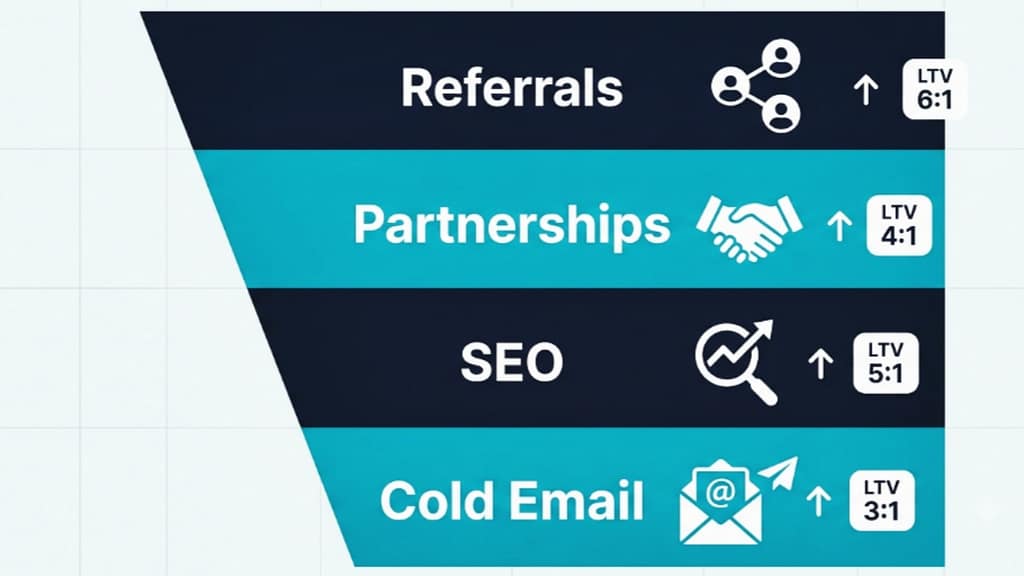
The chart below maps the four core SaaS acquisition channels by their mid-range LTV:CAC ratio — the single most important metric for evaluating whether a channel is economically sustainable at scale. Data sourced from the 2026 SaaS Acquisition Matrix, aggregated from founder-reported benchmarks across r/SaaS community research threads.
Mid-range LTV:CAC values shown. Referrals include warm intros, customer referrals, and review-site referrals. Paid ads excluded as a primary acquisition channel (signal testing use only).
The Four Pain Points Collapsing SaaS Acquisition Right Now
Before jumping into tactics, you need an honest diagnosis of why the traditional playbook is failing. These four pain points came up in virtually every thread the 2026 SaaS Acquisition Matrix research surfaced — across r/SaaS, r/SaaSMarketing, r/DigitalMarketing, and r/Entrepreneur.
1. Paid Ads: Rising Costs, Falling ROI
Community consensus across 2025–2026 threads is unambiguous: paid ads on platforms like LinkedIn and Google are now significantly more expensive while delivering less qualified pipeline per dollar. The community’s practical response is clear — paid ads should be used for signal testing and ICP message validation, not as a primary acquisition engine. Use them to discover which value propositions resonate with your ideal customer profile, then shift budget to channels with structurally superior LTV:CAC ratios.
“Use paid ads mainly for signal testing, not as the main acquisition engine. Find what resonates, then shift budget to channels with sustainable CAC.”
— Recurring community consensus, r/SaaS and r/SaaSMarketing threads, 2026
2. Cold Email Collapse: Mass Outreach Is Effectively Dead
Generic cold email — the spray-and-pray approach — has stopped converting. Community members across the research threads are blunt: cold outreach only works when it is tied to a specific narrative, case study, social proof, or clear ROI framing. Without one of these anchors, you generate spam complaints and damage your sending domain reputation without producing pipeline. Cold email still delivers a respectable 1.5–4x LTV:CAC ratio — but only for targeted campaigns of fewer than 50 personalized emails per week to pre-qualified ICP accounts showing active buying intent signals.
3. Broad Content Marketing: Too Slow Without Niche Focus
Chasing high-competition broad keywords is a resource trap for small SaaS teams. Community members who actually achieved SEO-driven pipeline growth did the opposite: they published 10–15 tightly focused articles targeting a single, specific pain point until they owned that micro-niche in search. This lets a 2–3 person team outperform larger competitors in a precisely defined segment. Broad keyword chasing, by contrast, produces content that never reaches page one and never compounds.
If you have ever found yourself creating content, updating pages, or researching new keywords instead of shipping or selling, read Productive Procrastination Is Killing Your SaaS — it is one of the most practically important mindset corrections in early-stage growth.
4. Activation Gaps: Paying Full CAC for Customers Who Churn Before Activation
Acquisition does not end at sign-up. A recurring insight across founder activation threads is that onboarding and activation improvements have a direct, underrated impact on effective CAC per retained customer. When users reach their first meaningful win quickly — within their first session or first week — churn drops and word-of-mouth referrals increase. Conversely, a leaky onboarding funnel means you are paying full acquisition cost for users who leave before the product delivers value. Fixing activation is often the highest-ROI intervention available to early-stage SaaS teams.
The 2026 SaaS Acquisition Matrix: Full Channel Comparison
Use the benchmark table below as your strategic planning reference before allocating time or budget to any acquisition channel. These benchmarks are drawn from founder-reported data aggregated across r/SaaS, r/SaaSMarketing, and r/Entrepreneur community threads in 2025–2026.
| Channel | LTV:CAC Range | Time to First Customer | Best Stage to Activate | Primary Risk |
|---|---|---|---|---|
| Referrals ⭐ Highest ROI | 6–20x | 1–3 months | After first 10 paying customers | Requires satisfied customers to activate; doesn’t self-scale |
| Partnerships & Integrations | 5–15x | 2–6 months | Post-PMF, with proven retention | Longer negotiation cycles; partner dependency risk |
| SEO / Niche Content | 4–8x | 6–12 months | Early (plant seeds now, harvest later) | Slow to start; fails without tight niche focus |
| Cold Email (Intent-Based) | 1.5–4x | 1–3 months | Any stage — ICP must be defined | Mass outreach is dead; requires personalization + signals |
| Paid Ads | Variable / low | Immediate | Signal testing only | Rising CPCs; use for message validation, not volume |
| Community Engagement | High (pre-scale) | Weeks (0–1 month) | Earliest stage — first 10 customers | Time-intensive; hard to scale beyond early stage |
Source: 2026 SaaS Acquisition Matrix · Aggregated from r/SaaS, r/SaaSMarketing, r/Entrepreneur community research. LTV:CAC ranges reflect verified founder-reported benchmarks across B2B SaaS products.

The Step-by-Step SaaS Customer Acquisition Action Plan for 2026
Here is the exact sequence that founders in the SaaS community are actually using to build sustainable acquisition engines. Follow this in order — prove each channel is working before moving to the next. Parallelizing too early is one of the most common ways small teams waste both budget and momentum.
STEP 1
Lock in Your First 10 Paying Customers Before Scaling Anything
The most common early-stage mistake is investing in scalable acquisition infrastructure — paid ads, SEO content, referral software — before having even ten paying customers. Community consensus from r/SaaS is direct: validate product-market fit with 10 paying customers first. This number is not arbitrary: ten customers give you enough signal to understand your ICP deeply, enough social proof to support referrals, and enough revenue to justify the next acquisition investment.
How to get to 10 before scaling:
- Direct personal network outreach — individual messages to contacts who have expressed the exact pain point your product solves. Not a mass email. One person, one message, one specific reason why their situation fits your solution
- Active community participation — contribute genuinely helpful answers in r/SaaS, r/SaaSMarketing, and niche Slack or Discord communities where your ICP gathers. Share your product when it is directly relevant to a discussion
- Reverse job posting — search for companies actively hiring for roles that indicate they need what you build. A company hiring a “Sales Operations Analyst” signals a need for sales ops tooling. Reach out directly to the decision maker
- LinkedIn journey documentation — post honest, specific updates about your product build. Founders who share real problems they are solving consistently generate warm inbound messages from prospects experiencing the same issue
For a systematic approach to finding where your ideal customers are already discussing their pain points, read How to Find SaaS Pain Points on Reddit and Build What People Need — it is the best tactical complement to this step.
STEP 2 — HIGHEST LTV:CAC
Activate Referrals First — Your 6–20x LTV:CAC Engine
Referrals deliver the highest LTV:CAC of any acquisition channel at 6–20x, with a 1–3 month ramp time once you have an active customer base to activate. Yet most founders ignore referrals in early stage or implement them too late, after trust has faded from early customers.
How to build a referral engine that compounds:
- Engineer the “first win” moment — your product must deliver a clear, measurable outcome within the first session or first week. Referrals come from customers who feel genuinely successful using your product, not merely satisfied
- Ask directly, personally, and immediately — after a customer hits their first meaningful win, send a personal email (not a referral form blast) asking for a warm introduction to one specific person with the same problem. The ask must feel personal, not automated
- Enable passive referrals at scale — at peak satisfaction moments, prompt customers to leave a G2, Capterra, or Product Hunt review. These function as persistent referrals across your entire ICP’s research journey, without your ongoing involvement
- Create reciprocal referral agreements — identify complementary SaaS tools that serve the same ICP without competing directly. Build a mutual referral arrangement where you send customers to each other when the use case fits
“Referrals give you the shortest path from ‘interested prospect’ to ‘high-intent buyer’ because trust is already transferred. You are starting the sales conversation at third base.”
— Synthesized insight from r/SaaS founder threads, 2026 SaaS Acquisition Matrix
STEP 3
Build Direct Distribution Through Partnerships and Integrations (5–15x LTV:CAC)
The phrase “direct distribution” emerged repeatedly in community threads as the alternative to broad awareness campaigns. The concept: instead of running ads to find where customers are, put your product directly into channels and ecosystems they already use and trust. Partnerships deliver a 5–15x LTV:CAC with a 2–6 month ramp time — and unlike paid ads, they compound over time without incremental spend per customer.
How to execute a partnership-led acquisition strategy:
- Native integrations in your ICP’s existing ecosystem — build into the platforms your customers already live inside. If your ICP uses HubSpot, build a HubSpot integration and list on the HubSpot App Marketplace. You gain access to their entire, qualified ICP without a single paid impression
- Community sponsorships that add value — sponsor Slack groups, Discord servers, or newsletters where your ideal customer actively participates. Not passive banner ads, but content-contribution sponsorships that provide genuine utility to the community
- Co-marketing with complementary tools — partner with non-competing SaaS products serving the same ICP for joint webinars, content swaps, or limited bundle promotions. Both lists grow; both products gain qualified exposure
- Certified consultant and agency partner programs — identify consultants and implementation agencies who already advise your ICP. Create a partner program with revenue sharing that makes recommending your product economically attractive for them
Once you have partnership-generated demand flowing, the next layer is adding a profitable paid amplification engine on top. See Scaling SaaS With Ads: The B2B Founder’s Profitable Growth Playbook for exactly how that layer is built.
STEP 4 — GROWTH HACK
The “Ungated Value” Strategy: Let Your Product Acquire Customers
One of the most underused acquisition strategies in B2B SaaS is deploying the product itself as a growth engine. Shortening the path from first use to first win dramatically reduces effective CAC by improving conversion at every stage of the funnel. The “Ungated Value” strategy operationalizes this principle across multiple touchpoints.
- Free micro-tools and calculators — build single-purpose free tools that solve one specific problem your ICP faces. They attract organic search traffic, build trust, and warm up future paid customers with zero ad spend. See how this model works in practice at Time-Saving Tools 2026 – Reclaim 100 Hours
- Freemium with a precision value-unlock moment — offer meaningful free access, but engineer a specific moment where the user hits a natural limit that makes upgrading feel obvious rather than forced. The limit should feel like a milestone, not a wall
- AI-guided on-demand demos — instead of gating your demo behind a 30-minute sales call, offer an interactive, AI-powered product walkthrough that delivers real use-case value immediately. The playbook for this is in How to Get Users Using ChatGPT: The Founder’s Playbook for AI-Driven Signups
- First-win activation engineering — redesign your entire first-session experience around a single, concrete outcome the user achieves within 10 minutes. Not a feature tour. A real result that makes the value of your product immediately undeniable
STEP 5 — LONG-TERM COMPOUNDING
Build a Niche SEO Authority Machine — Not a Content Farm (4–8x LTV:CAC)
SEO has the slowest ramp time of any acquisition channel — 6–12 months before meaningful organic traffic appears — but delivers a 4–8x LTV:CAC with zero incremental cost per additional visitor once established, and it compounds indefinitely. The critical insight from community research: broad keyword chasing fails entirely for small teams. Niche dominance wins.
Community members who saw real SEO traction published 10–15 high-quality articles targeting a single, precisely defined pain point — enough to establish genuine topical authority in a micro-niche while larger competitors ignored the low-volume keywords.
- Target one pain point cluster, not isolated keywords — map every question, comparison, how-to, and use case around a single problem your ICP faces. Build 10–15 interconnected articles that collectively own that topic in search
- Prioritize KD below 30, search volume 500–5,000 — low-competition, high-intent keywords that established players ignore because the volume appears small. Collectively they drive highly qualified, conversion-ready traffic
- Lead every article with an immediate answer — readers who get direct value within the first paragraph bookmark, share, and return. Bury the answer behind a 300-word preamble and they bounce
- Build tight internal linking within your cluster — dense internal links between cluster articles signal topical authority to search engines and improve rankings across the entire cluster
For lessons on what kills SaaS products before SEO ever compounds — and how to avoid them — read How to Success a SaaS: 10 Battle-Tested Lessons From Building (and Killing) 15 Products.
STEP 6 — PRECISION OUTREACH
Cold Email — The Right Way: Intent Signals + Case Studies (1.5–4x LTV:CAC)
Cold email still delivers a 1.5–4x LTV:CAC — the lowest of the four core channels but still economically viable when executed correctly. The fundamental requirement: highly targeted campaigns of fewer than 50 deeply personalized emails per week to pre-qualified ICP accounts showing active buying intent signals. Not 500 generic blasts per day.
The intent-signal framework that is converting in 2026:
- Target with intent signals, not just firmographics — prioritize accounts showing behavioral buying signals: recent competitor reviews on G2 or Capterra, new technology adoption detectable via tools like BuiltWith, recent funding announcements, or specific LinkedIn post engagement suggesting active evaluation
- Open with a directly relevant case study — begin with a one-sentence description of a similar company you helped, the specific measurable result they achieved, and why the prospect’s situation is analogous. This replaces the generic “we help companies like yours” opener entirely
- Frame around ROI and specific outcomes, not features — community research shows that “we saved [Company X] 8 hours per week on [specific task]” dramatically outperforms any feature-listing opener. Concrete outcomes convert; feature lists do not
- WhatsApp or LinkedIn DM follow-up for silent prospects — community members report that silent prospects who did not respond to email converted at meaningful rates via a brief, respectful LinkedIn DM or WhatsApp follow-up sent 5–7 days after the initial email
E-E-A-T Summary: SaaS Customer Acquisition Best Practices for 2026
Here is the consolidated best practices reference table — a single-page strategy summary grounded entirely in the 2026 SaaS Acquisition Matrix community research data. Pin this. Refer to it every time you allocate acquisition budget or time.
| Best Practice | Why It Matters | Channel | Verified Source |
|---|---|---|---|
| ✅ Secure first 10 paying customers before scaling any channel | Validates PMF; creates the customer base that enables referrals and social proof | All channels | r/SaaS community consensus, 2026 |
| ✅ Activate a referral program immediately at 10+ customers | Highest LTV:CAC (6–20x); trust is pre-transferred from referrer to prospect | Referrals | 2026 SaaS Acquisition Matrix |
| ✅ Use paid ads for signal testing only — not volume acquisition | Avoids wasted CAC on structurally expensive channels with shrinking ROI | Paid Ads | r/SaaS, r/SaaSMarketing threads |
| ✅ Publish 10–15 focused articles on one specific pain point | Enables small teams to establish topical authority and dominate a niche in SEO | SEO / Content | r/SaaS community research |
| ✅ Send fewer than 50 personalized cold emails per week with case studies | Intent-based precision converts; mass outreach damages domain and produces no pipeline | Cold Email | r/SaaSMarketing, r/Entrepreneur threads |
| ✅ Build integrations into your ICP’s existing tool ecosystem | Creates direct distribution into your ICP’s workflow without awareness spend | Partnerships | r/SaaS, r/SaaSMarketing threads |
| ✅ Engineer a “first win” experience within the first 10 minutes of onboarding | Reduces churn-adjusted CAC; drives organic referrals from activated, satisfied users | PLG / Onboarding | r/SaaS activation discussion threads |
| ✅ Sequence channels by LTV:CAC, not by familiarity or comfort | Most founders default to paid ads (lowest ROI) instead of referrals and partnerships (highest ROI) | Strategy layer | 2026 SaaS Acquisition Matrix |
Frequently Asked Questions: SaaS Customer Acquisition Strategy
What is a SaaS customer acquisition strategy?
A SaaS customer acquisition strategy is a channel-specific, data-driven plan for attracting, converting, and retaining paying customers at a CAC low enough to sustain healthy unit economics — specifically, an LTV:CAC ratio of 3x or higher. In 2026, the most effective strategies sequence channels in order of LTV:CAC efficiency and time-to-revenue: referrals and direct outreach first, partnerships next, niche SEO for long-term compounding, and cold email as a precision supplement. The strategy must also account for onboarding and activation, since high churn after sign-up effectively raises the real CAC per retained customer.
Which customer acquisition channel is best for SaaS?
Based on the 2026 SaaS Acquisition Matrix, referrals deliver the best LTV:CAC at 6–20x, followed by partnerships at 5–15x, SEO at 4–8x, and cold email at 1.5–4x. However, the “best” channel depends on your current stage. Referrals require an existing customer base to activate. SEO requires a 6–12 month runway before meaningful traffic. Partnerships need 2–6 months to negotiate and launch. For a pre-10-customer startup, direct personal outreach and community-based acquisition within r/SaaS and niche Slack groups are most immediately appropriate, because they can generate paying customers within weeks.
How do SaaS companies reduce CAC?
SaaS companies reduce CAC by (1) shifting budget from high-CPC paid channels to higher-LTV:CAC channels like referrals and partnerships, (2) improving onboarding and activation so fewer users churn before the product delivers its core value, (3) building 10–15 tightly focused SEO articles that compound organic acquisition over time without recurring ad spend, and (4) restricting cold email to intent-signal-based precision outreach supported by relevant case studies — not mass volume. Each of these approaches was surfaced as a working solution across 2025–2026 SaaS founder community research, and each directly addresses a different dimension of the CAC problem.
Is SEO or paid ads better for SaaS acquisition?
For long-term unit economics, SEO is structurally superior — delivering a 4–8x LTV:CAC with zero incremental cost per additional organic visitor once established. Paid ads have rising CPCs and are recommended in community research primarily for signal testing and ICP message validation, not as a primary acquisition engine. The core tradeoff is time: SEO takes 6–12 months before generating meaningful results, while paid ads produce immediate traffic. The sequence that works — and that community members consistently recommend — is to use paid ads to discover which messages and value propositions resonate with your ICP, then build SEO and referral infrastructure around those highest-converting angles.
How do you acquire the first SaaS customers?
Community consensus from r/SaaS and r/SaaSMarketing is to use direct, personal outreach first — individual messages to people in your existing network who have expressed the pain point your product solves. From there, active participation in r/SaaS, r/SaaSMarketing, and niche Slack or Discord communities where your ICP gathers generates warm interest without any ad spend. “Reverse job posting” — finding companies hiring for roles that signal they need your product, then reaching out to the decision maker — is specifically mentioned as an effective early-stage tactic. Target 10 paying customers as your first concrete milestone before investing in any scalable acquisition infrastructure.
What is a good LTV:CAC ratio for SaaS?
The 2026 SaaS Acquisition Matrix shows channel-specific benchmarks ranging from 1.5–4x for cold email to 6–20x for referrals. The widely accepted industry standard is that a 3:1 LTV:CAC ratio or higher is healthy — meaning every dollar spent on customer acquisition should generate at least $3 in lifetime value. For B2B SaaS products with higher annual contract values, ratios of 5–10x are achievable and considered excellent. Ratios consistently below 3x indicate either excessive acquisition costs, insufficient retention, or both — and require intervention at the channel, onboarding, or product level before scaling acquisition spend.
How does ABM work for SaaS?
Account-Based Marketing (ABM) for SaaS involves identifying a curated list of high-value target accounts and coordinating personalized marketing and sales touchpoints specifically for each account — rather than running broad campaigns and waiting for leads to self-identify. In 2026, effective ABM for B2B SaaS intersects directly with the intent-signal-based cold outreach framework: identify target accounts showing active buying signals (competitor G2 reviews, technology stack changes, relevant hiring patterns, funding events), then orchestrate a personalized multi-touch sequence across email, LinkedIn content, and targeted retargeting. ABM is most economically justified for enterprise-focused SaaS with high ACV, where the acquisition economics support account-level personalization investment.
How long does SaaS customer acquisition take?
Timeline varies significantly by channel, based on the 2026 SaaS Acquisition Matrix: referrals generate customers in 1–3 months once an active customer base exists; cold email delivers in 1–3 months for well-targeted campaigns; partnerships require 2–6 months to negotiate, activate, and generate meaningful referral volume; and SEO takes 6–12 months before delivering reliable organic traffic. For pre-product-market-fit founders, the fastest path to first revenue is direct personal outreach and community participation — achievable in weeks, not months, when messaging clearly addresses a specific, painful, immediate problem your ICP recognizes.
Ready to Build Your SaaS Customer Acquisition Engine?
The playbook is clear: start with your first 10 customers, activate referrals, build partnership distribution, plant your niche SEO cluster, and only then amplify with paid channels. Every channel has a role — but sequence matters more than budget. Founders who rush to paid ads before building the referral and partnership foundation consistently pay 3–10x more per customer than those who follow the sequence above.
Deepen your SaaS growth strategy with these companion articles on Klyzed:
- How to Success a SaaS: 10 Battle-Tested Lessons From Building (and Killing) 15 Products
- Scaling SaaS With Ads: The B2B Founder’s Profitable Growth Playbook
- How to Find SaaS Pain Points on Reddit and Build What People Need
- How to Get Users Using ChatGPT: The Founder’s Playbook for AI-Driven Signups
- Productive Procrastination Is Killing Your SaaS