

Short Answer
To reduce SaaS churn, fix the three leaks in order: activation (get users to a real “aha moment” fast), billing (dunning and card recovery reclaim 10-20% of “dumb churn” instantly), and cancellation (replace the delete button with pause, downgrade, and discount options). Teams that fix all three report cutting churn by 30-40% within the first month, without touching pricing.
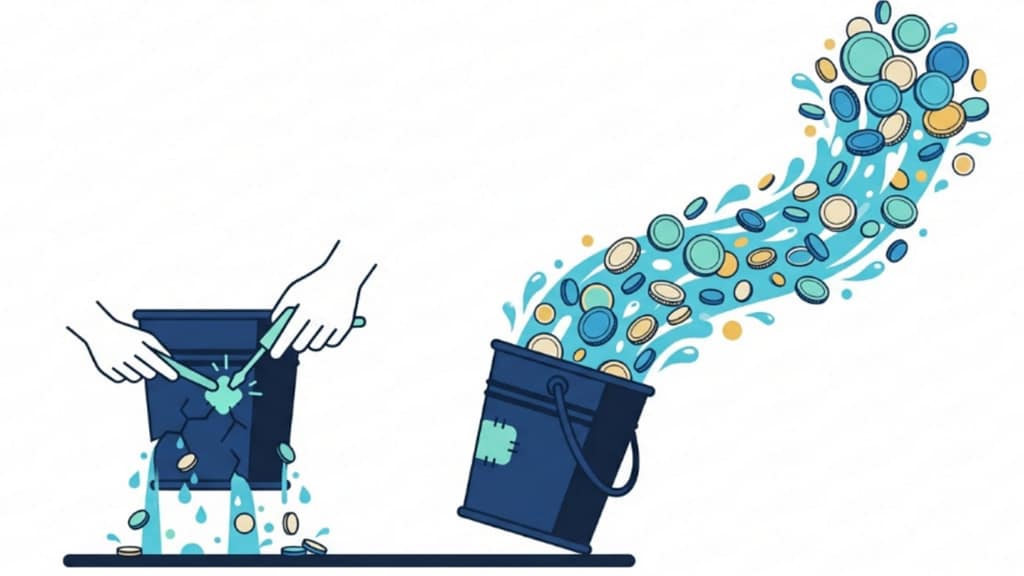
Churn Is Not a Metric. It’s a Leaky Bucket.
Walk through any founder thread on Reddit’s r/SaaS or r/B2BSaaS right now and you’ll see the same panic, worded differently every time: “churn is killing our ARR,” “we’re stuck on a leaky bucket,” “tool fatigue is eating us alive.” It’s not paranoia. Every new AI competitor and every cheaper alternative makes it one click easier for a customer to cancel.
Here’s what makes churn so frustrating to fix: most of it never gets explained to you. Customers “churn without ever telling us why.” They say it’s “too expensive” or “not using it enough,” but that’s rarely the real story. The real story usually lives in one of three places: they never got value, their card expired, or your cancel button gave them no reason to stay.
Before we get into the fix, it helps to know where you actually stand. If you haven’t mapped your own customer acquisition strategy against your retention numbers, churn will always look scarier than it is, because you won’t know if you have a growth problem or a leaky-bucket problem.
What “Good” Churn Actually Looks Like
Before optimizing anything, benchmark yourself. Community-reported ranges across indie and B2B/B2C SaaS are consistent enough to use as a target:
The ultimate goal isn’t zero churn, it’s negative net revenue retention, where expansion revenue from existing accounts outpaces what you lose to cancellations. That’s the ceiling. Everything below is the floor you’re trying to climb off of.
The Four Leaks: Where Churn Actually Comes From
Reddit and Indie Hackers threads consistently point to the same four failure points. None of them are solved by “adding more AI.” As one founder put it bluntly: “There’s no miraculous platform that will eliminate your churn… it all comes back to your product.”
| Leak | What It Looks Like | Reported Impact |
|---|---|---|
| Weak activation | Users never hit an “aha moment”; onboarding feels like plugging in an octopus of setup steps | Root cause of most silent churn |
| Involuntary churn | Expired cards, failed payments, no dunning logic | 10–20% of total churn, recoverable |
| Dark cancellation flows | A single “delete my account” button, no survey, no counter-offer | Zero feedback, zero save opportunity |
| Tool & stack bloat | Three retention tools duct-taped together, none owned by anyone | Predictions generated, no one acts on them |
“AI predictions are just an engine; without processes and interventions, the models don’t save accounts.”
If your onboarding is the weak link, this is worth fixing first — it’s the same groundwork covered in our SaaS onboarding checklist, and it’s usually the highest-leverage place to start because every other fix below depends on users actually reaching value.

The Step-by-Step Plan to Reduce SaaS Churn
Step 1: Define and Instrument Activation Events
Stop guessing what “success” means for a new user. Define a specific activation event per persona, then instrument it with a product analytics tool like Amplitude or Mixpanel. Track time-to-first-value, weekly active seats, feature coverage, admin logins, integration failures, and support sentiment — these are the exact signals that show you where users get stuck before they ever complain.
One founder implemented a three-step in-app success checklist paired with segment-specific Loom walkthroughs and cut month-one churn by approximately 30%. Personalized concierge calls consistently outperformed generic webinars for the same reason: they’re built around one persona’s actual “aha moment,” not a demo script.
Step 2: Fix Involuntary Churn First (It’s the Cheapest Win)
Before touching product or pricing, fix billing. Involuntary churn — expired cards, failed payments, lapsed authorizations — often represents 10–20% of total churn in subscription SaaS. None of it requires convincing anyone to stay; it’s just recovering money that was never meant to leave.
- Smart dunning email sequences timed around retry attempts
- Automatic card retry logic instead of a single failed charge
- Card updater integrations that catch expirations before renewal
- Proactive payment update reminders 45 days before a card expires
This stack alone is reported to recover 20–40% of churning revenue for indie SaaS and subscription products — pure ARR added back with zero product changes.
Step 3: Replace the Delete Button With a Real Cancellation Flow
A single “delete my account” link is the most expensive button in your app, because it captures zero data and zero save opportunity. Products like dontchurn.io turn that button into a decision point: discount, pause, downgrade, or feedback. Reported results are a 30–40% reduction in churn within the first month of implementation.
Stripe‘s own billing benchmarks back this up: tailored counter-offers presented at the moment of cancellation can cut cancellations by as much as 30%. Two tactics outperform a flat discount:
- Pause for 60 days instead of cancel — frequently outperforms discounts for users who “don’t need it right now but might come back”
- Time-limited discount (e.g., 50% off for 2 months), used only once per account so you don’t train users to churn for a deal
Step 4: Predict, Then Map Reasons to Specific Playbooks
Prediction without action changes nothing. Build a weekly survival or rolling classification model on features like inactivity thresholds (21 days is a common flag for self-serve risk), billing risk signals, sentiment, and external noise spikes. Then route every flagged account into a specific playbook by reason, not a generic “at-risk” email:
| Churn Reason | Playbook |
|---|---|
| Low adoption | Webinar + in-app checklist |
| Feature gap | PM call or roadmap alternatives |
| Budget risk | Term flexibility, right-sizing seats |
| Billing | Dunning + alternate payment methods |
| Champion change | Executive outreach to the new decision-maker |
Start this at least 90 days before renewal, not at the renewal date. Teams that identify at-risk accounts 90+ days out and act on specific risk factors report cutting churn by 40% or more.
Step 5: Run Empathy-First Win-Back Campaigns
Add short, well-timed cancellation and NPS surveys with specific reason codes: “too expensive,” “missing features,” “switched to competitor,” “no longer need it.” Community-reported distributions typically skew toward “too expensive” at around 40% and “missing features” around 30% — both directly actionable for pricing tiers and roadmap prioritization.
When a refund is requested, don’t just process it. Reach out, listen before pitching anything, then offer a short-term discount paired with a clear “full refund if this still doesn’t work” guarantee. CS practitioners call this “Empathy Extraction,” and it’s reported to save accounts without heavy sales pressure. Segmenting churned users by reason and running targeted win-back campaigns is how some teams cut churn by 40%+ over full renewal cycles.
Best Practices Checklist
| Practice | Why It Works |
|---|---|
| Instrument activation events per persona | Turns “they churned without saying why” into a measurable funnel |
| Fix dunning and card recovery first | Recovers 20–40% of churning revenue with zero product changes |
| Replace delete with pause/downgrade/discount | Cuts churn 30–40% and captures a reason code every time |
| Flag risk 90+ days before renewal | Gives time for a playbook, not just a farewell email |
| Build community after first milestone | Retains users longer than discounts by creating peer belonging |
| Measure uplift, not just model accuracy | Ensures interventions actually move retention, not just prediction scores |
If you’re earlier in the funnel and churn is really an acquisition-quality problem in disguise, it’s worth revisiting how you’re reducing B2B SaaS customer acquisition costs — cheap, poorly-matched signups almost always show up later as high churn.
FAQ
What is a good monthly churn rate for a SaaS company?
Under 5% monthly is acceptable for B2C SaaS, under 3% for B2B SaaS, and best-in-class indie SaaS operators target 1–2%. The real ceiling is negative churn, where expansion revenue outpaces cancellations entirely.
How much churn is caused by failed payments, not dissatisfaction?
Involuntary churn from expired cards and failed payments typically accounts for 10–20% of total churn. It’s often called “dumb churn” because dunning emails, retry logic, and card updater tools can recover it without any customer conversation.
Do cancellation flow tools like pause or downgrade actually reduce churn?
Yes. Cancellation-flow products offering discount, pause, or downgrade options are reported to reduce churn by 30–40% within the first month, and Stripe’s benchmarks show tailored counter-offers at cancellation can cut cancellations by as much as 30%.
How early should I flag an at-risk account before renewal?
At least 90 days before renewal. Teams that identify risk this early and route accounts into reason-specific playbooks (adoption, feature gap, budget, billing, champion change) report cutting churn by 40% or more, versus reacting only at the cancellation moment.
Still hunting for the exact pain points your churned users are venting about? Our guide on finding SaaS pain points on Reddit walks through the same research method used to compile the language and benchmarks in this article.